Showing posts with label Bechamp. Show all posts

Sunday, October 26, 2008

From where does this method come?

The history of the dark field blood diagnostics begins already in the year 1801 with James Adam. Were noticeable to it as first living primitive forms in a Mamma carcinoma cut. It gave thereby enormous research impulses. 1866 described professor Béchamp a hypothetical cycle of the alive substance. Based on it developed it the basic ideas of the Pleomorphismus (many forms). Louis Pasteur as a contemporary Béchamps had another, just as hypothetical view to the living substance. Its model for further discussion was that of the Monomorphismus.

O2-Zap 468x60 European Secret


Related Sites:
Alkaline Diet
Introduction - pH
Live Blood Analysis
Live Blood Analysis Course
Live Blood Analysis Equipment
pH Buffer System
pH Range
pH - Test

Monday, September 08, 2008

SANUM Therapy: Puzzling Medicine putting the pieces together

by Kirk R. Dr. Slagel

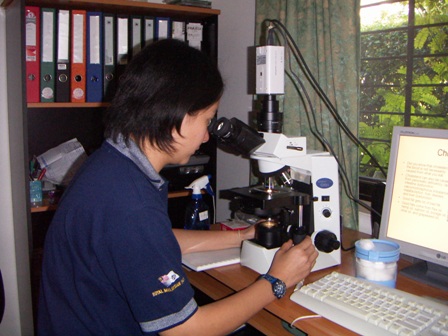
Since the time that German Professor Dr. Guenther Enderlein stood behind the eyepiece of his darkfield microscope, much has changed in the world of Isopathic/Homeopathic medicine. Dr. Enderlein studied blood, live blood, via a darkfield microscope; a specially designed microscope that angles the light through the viewing plane as compared to a bright field microscope that points the light directly upward through the viewing plane. The difference: bright field light washes out objects that may be seen with a darkfield scope. This darkfield difference however, allows minute microscopic objects to be visible to the human eye that otherwise would be lost in the sea of light normally flowing through the eyepiece of a bright field scope. Much like the disappearance of stars in the light of day that become visible by the absence of light when the sun sets, darkfield microscopy sets free the hidden forms that exist deeper in the universe of a drop of blood.

Dr. Enderlein spent thousands of hours, culminating many years of his life studying this microscopic universe. He based his initial work on Antoine Bechamp, the French researcher who while performing his own research on the microbiological world coined the term "Microzymas" for the minute forms he found. The first real point in time noted for Dr. Enderlein was during his work in 1916 when he was studying typhoid. He cited the observance of objects and forms, moving structures in the blood besides those mobile scavengers, the white blood cells. But of particular interest was that these structures appeared to change form; they underwent a pleomorphic process. Bechamp's Microzymas did the same.

Dr. Enderlein was not the only researcher during that time that noted these pleomorphic structures. There were a number of other medical health professionals in the late 1800's and early 1900's who had also observed various pleomorphic microbe forms in the body. Lida Mattman, PhD in her book Cell Wall Deficient Forms: Stealth Pathogens mentions similar findings in research conducted by Willibald Winkler, MD, Ernest B. Almquist, MD, Emmy Klieneberger, Nobel Prize winner in 1950, and many others. In addition, Dr. Mattman states that Louis Dienes, Honorary Member of the American Society for Microbiology, developed an incubator to grow cell wall deficient forms. As her book indicates he may very well be the person who shed light on these multi-formed pathogens to the US investigators. However, different than the other researchers, Dr. Enderlein expanded his work to include the resultant medicines he developed from those many hours of darkfield assessment. Continue Reading >>

Friday, September 05, 2008

The Truth About The Virus

The following are several references on the definition for the word virus. You will note that the latin word for virus is poison.

The truth about a virus is that a virus is a liquid poisonous dietary and/or metabolic acid. It is NOT a microbe!

You do not catch a virus. Viruses are not sexually transmitted. The virus is an acidic waste product from an inverted way of living, eating and thinking.

From Webster's New Twentieth Century Dictionary,
1975

virus, n.[L., poison.]

1. venom, as of a snake
2. (a) any of a group of ultramicroscopic or submicroscopic infective agents that cause various diseases, as smallpox: viruses are capable of multiplying in connection with living cells and are variously regarded as living organisms and as complex proteins;
(b) specifically, a filterable virus;
(c) the exudation from the vesicles of cowpox, used as vaccine for smallpox.
3. that which corrupts or poisons the mind or character; evil or harmful influence.


From Oxford English Dictionary

Virus [L virus slimy liquid, poison, offensive odour or taste. Hence also F., Sp. Pg. virus.]

In Lanfranc's Cirurgie (c 1400)77 the word explained as ' a thin venomy quitter' is merely taken over from the Latin text.

1. Venom, such as is emitted by a poisonous animal. (dated quotations)
2. Path. A morbid principle or poisonous substance produced in the body as the result of some disease, esp. one capable of being introduced into other persons or animals by inoculation or otherwise and of developing the same disease in them. (dated quotations)
3. fig. A moral or intellectual poison, or poisonous influence. (dated quotations)
4. Violent animosity; virulence. (one dated quotation)

From The Encyclopedia Americana, 1958

Virus, Infectious disease-producing agent largely characterized by small size and ability to reproduce only within living cells, that is a minute, obligate parasite.

Discovery of the chemical nature and crystallization of tobacco mosaic virus (the first virus acid discovered) by Wendell M Stanley in 1935 (Science, June 28, 1935) opened the way for purification and intensive study of viruses or crystal acids.

(Dr. Stanley brought Dr. Peter Duesberg to Stanley Hall in Berkeley in the 1960s. Dr. Duesberg wrote the book, Inventing the AIDS Virus)

Now, to get your heads on straight, there is a piece from "The Blood and Its Third Anatomical Element" by A. Bechamp

Pages 210-211.

"An eminent surgeon, M. Verneuil, ended by admitting as a demonstrated theorem that there is no spontaneous tetanus, that there is no spontaneous small pox, syphilis, glanders, hydrophobia, tuberculosis (tell this to the CDC and Mr. Speaker, the attorney from Atlanta diagnosed with TB and his Doctors), carbon or malignant pustule; declaring that the pathogenic problem consisted solely in discovering how and when the microbe, also called virus, come from without, penetrates into the organism; declaring that the question is thus stated between old medicine and the microbina medicine with extreme simplicity and without the least ambiguity."

"But these assertions (of Surgeon Verneuil) are reduced to nothing, when we call to mind that the pretended germs of the air are only the microzymas of organisms which have disappeared, which had become bacteria by evolution; that even at the Acadamy of Medicine I said--and no one ventured to contradict me on the nosological roll by taking the pretended pathogenic microbe in normal air, but only in the diseased animal."

I must say that I am indebted to both Dr. Antione Bechamp and Dr. Verneuil for saving ourselves and whatever is left of our civilization from the peril of a viral microbe dogma and from current vival medical treatments, for those who have ears to hear and eyes to see.

Bottom line, the present of a virus or a crystal acid or a bacterium such as TB, is not caused by infection, but is caused by personal lifestyle and dietary choice.

The key to health, energy and vitality is simple - maintain the alkaline design of your body with cholorphyll, nascent oxygen, alkaline water, healthy polyunsaturated fats, and mineral salts.

Monday, August 04, 2008

Antoine Bechamp

Bechamp was one of France's most prominent and active researchers and biologists. He taught in universities and medical schools, and published widely on cell biology, disease, botany and related subjects. His would probably be a household name today if it wasn't for the activities of one Louis Pasteur, who history has treated very kindly indeed, considering his fake science, his tendency to steal ideas (mainly from Bechamp), falsify experimental data, and in general make claims which had no basis in fact.

I'm not running off at the mouth by saying the above. It's all quite well documented - Bechamp and Pasteur were both members of the French Academy of Sciences, and the papers they submitted, and their correspondance, both to each other and to other people, were all recorded. Even their verbal exchanges survive in the minutes of the meetings.

To cut a long story short, and it is a long story, Pasteur basically dug up the germ theory of disease and put his name on it. It wasn't a new idea, although he claimed to have "discovered" germs all the same. The concept had actually been outlined by other people many years before, but of course, the whole idea is wrong anyway, so it hardly matters who thought of it first. In a few years, the germ theory of disease will out there with the flat earth theory where it belongs.

Sunday, August 03, 2008

Germs and Viruses. Part 4

In 1898, Guenther Guenther Enderlein (1872-1968) graduated with honors in natural sciences, physics and zoology from Leipzig University, and in 1914 he became a bacteriologist and serologist at the German military hospital at Stettin.

Enderlein had studied the findings of Antoine Bechamp and had further studied under Rudolph Leuckart, the zoologist who initiated the modern science of parasitology, and also under Otto Schmidt, the doctor who in 1901 reported the discovery of parasites in the blood of cancer patients. (Schmidt was not the first to discover cancer parasites. As early as 1890 Scottish pathologist William Russell reported on widely variegated microbes present in all cancer tissue, which microbes were referred to as "Russell bodies".) Continue Reading >>

Saturday, August 02, 2008

Synthesis of the Work of Enderlein, Bechamps and other Pleomorphic Researchers

All mammals and most likely all other animals have two parasites. They are in a particular relationship and supplement each other.
Those two parasites or endobionts are called Mucor racemosus Fresen and Aspergillus niger van Tiegham.

Bechamp, Rife and Naessens could demonstrate that they are virtually indestructible. Neither carbonizing temperatures nor radioactive radiation can harm them.

Enderlein believed that they entered the cells of higher differentiated cell colonies as parasites while Antoine Bechamp believed that they are the essence of life in the cell.
The endobiont is always present and cannot be removed from the living cell; the clinical symptoms of a disease depend on the stadium of its development. This "fungal parasite" can be present in all tissues and organs.

Today's mainstream medicine is governed by consent of opinions rather than hard scientific evidence. This is the reason why false and fraudulent teachings can survive even though the truth has been known for a long time. Continue Reading >>

Saturday, March 01, 2008

The history of the Monomorphismus and Pleomorphismus

Angelika writes "
The history of the Monomorphismus and Pleomorphismus

Approximately around 1898 a controversy among the scientists over the kind, the nature and the behavior of the bacteria began. Up to then one knew the spleen fire exciters, the Cholera germ, the Diphtheria, typhoid fever, Tuberculoses and the Syphilis germ.

Mainly two thinking directions took the true nature up of the bacteria for itself to know. Some stated, bacteria are not capable of changing their appearance; the other stated the opposite: the fact that under certain conditions bacteria quite change and/or another shape to accept and develop themselves further can.

The first group were the Monomorphist (of griech. monomorph - one form), the second group were the Pleomorphist (of griech. pleomorph - many forms).

Louis Pasteur (1822-1895) was a Monomorphist, on its dying bed however explained it the important sentence:THE ENVIRONMENT IS NOT EVERYTHING THE MICROBE IS ANYTHING .It professed itself to the Pleomorphismus.

Founder of the Pleomorphismus was the Frenchman Antoine Bechamp. Since then we have to do it with a constant change of the micro organisms: not ill-making the only by antibiotics and all chemical weapons since then against, but also against the physiologically good (healthy-holding) bacteria to be used, the micro organisms constantly develop themselves further into higher valence forms (ill-making forms); indeed in viruses, bacteria and mushrooms.

The fighting medicine tries to fight and defeat the cancer for over 100 years. "as the victory from....?" sees

By epidemics, e.g. AIDS and SARS, clearly shown us that viruses always develop themselves further into newer and more aggressive manifestations.

Fight always produces a fight. We hear to nevertheless finally fight on!

LOVE is the largest STRENGTH in the COSMOS.

Only by the holistic viewpoint, the CYCLOGENY (CYCLOS means CIRCLE, gene OS birth), we can use natural cures modulator. These modulators know under certain conditions the degenerate micro organisms viruses, bacteria, mushroom again into the prototype, which Endobiont, back to bring.

Monomorphist starting points are: linear
Pleomorphist starting points are: three-dimensional
Holistic starting points are: four-dimensionally

We are in the beginnings of the water man age, in which four-dimensional the way of life and thinking outweigh. In the course of this age we will learn holistic to live. All diseased, degenerate forms are back developed by the law of the holistic viewpoint into the healthy form. This Holistic in the water man age means lived courageous acting LOVE.

Dark field blood diagnostics
Method of Professor Dr. Guenther Enderlein (1872-1968), that primarily a biologist and a zoologist was 1916 came from Enderlein a first report over a revolutionary reorganization of the bacteriology.

Dr. William of Brehmer (1883 - 1958) discovered 1928 the blood parasites Siphonosphora polymorpha in the red blood corpuscle of humans, which can develop itself further under certain conditions to diseased forms. The special at of Brehmer the method is coloring native or vital blood on a slide, whereby certain high valence forms become visible. By the advancement of the technology to the phase contrast microscope, it is to be regarded us today possible certain forms without coloring immediately.

Most important aspect also for of Brehmer is clarifying the acid Base environment in the organism. It developed for it the Haemo Ionometer. Robert-Koch-Institute with the Humboldt university in Berlin, under which line of the then world-famous Hematology Professor Dr. Victor Schilling confirmed to 1935 that Siphonosphora polymorpha the second genuine blood parasite is, which develops in the Erythrocyte.

First up to then admitted blood parasite was the Plasmodium malaria. Thus Brehmers discovery was scientifically certified and in the medical professional world recognition. The exciters go through a specific cycle, as the training medicine and bacteriology accept it with malaria as natural. The training medicine until today recognizes the development stages of viruses, bacteria and mushroom forms however not on. Although there is nevertheless no exception of the law of the eternal change and the unit of the macrocosm with the microcosmic (e.g. Qualquappe' Frog, Raupe' Butterfly) in whole nature.

Cyclogenie means the transformation and migration of all pathogen and not pathogen germs by all phases (valences) of the border of the visibility, and among them the virus range, over the higher valence phases of the text book-in accordance with-eaten Kokken and the staebchen up to the kulminanten phases of the mushrooms and their Myzelien.

The bacteria core (Mych) plays an important role, the moreover the pH value, i.e. the acid Base household of the organism of humans (to the comparison: as is the case for the aquarium). Only if the environment is not correct, the pathogen development can take place. Either asexual by division or on sexual way by Sprouting after preceding nuclear fusion. The principle of the Polymorphic was confirmed 40 years after Enderlein by the Nobel leather castle.

more information:
http://www.dreddyclinic.com/faq_live_blood_microscopy_1.htm

Wednesday, May 23, 2007

The Fairy Tale of E-coli Causing Sickness and Death

This was an email sent to me today concerning E-coli from spinach causing sickness or even death. It came as a result, I am quite sure, of the AOL news coverage and the hour-long CNN documentary which has been running all weekend about the spinach scare in 2006, farming practices, the problems of the FDA, the wrongly theorized cause, the supposed remedies, and lawsuits and so on.

It also highlighted the death of an elderly woman and the near-death of a little girl. I am always a bit suspicious and fearful of news media, like politicians, who spend too much time telling me what to be afraid of and who to blame." This is especially true when most of the accompanying ads seem to be from the pharmaceutical industry.

I am sharing with you my thoughts and response to questions. The host and interviewer of the piece was Dr. Sanjay Gupta, CNN's medical correspondent.

Here is the email letter:
"Dear Dr. Young "I was just wondering if the "germ" finds a friendly environment (over acidic), can it multiply and create more waste and therefore there is a possibility of exposure that leaves an acidic body in jeopardy.

"Obviously E-coli has been used for ages in classrooms (because it doesn't take much to provide it with the necessary ingredients for quick replication for observation) without hurting anyone, but if for some reason, some crazy kid decided to lick his slide and the internal terrain was compromised already, would the e-coli (or any other bacteria) then be able to replicate internally and produce enough waste to tip the balance (though I would have thought it would take ages)? Or is that really out of the question? Clearly the focus is bas-ackwards (as they say) in western etiology.

"When a group of kids who have been mistakenly identified as being "struck" by E-coli from a bad meat source, is it simply that the "'bad" (is there any good? : ) meat has become so acidic that it is like drinking industrial solvents? Would chemical tests of the suspect sources reveal the problem? Biological interpretations appear to be just wrong.
"Thank you so much for taking the time to answer these!"
Sally

Dear Sally: Thank you for your email questions. I have stated in my writings that germs (the "germing" process) cannot cause disease but "germs" themselves do produce digestive (enzymes) or metabolic waste products called exotoxins and mycotoxins or simply acids that contribute to disease states.

I have further stated that there is only one cause of sickness, dis-ease and death and that is the over acidification of the tissues (latent tissue acidosis) and then blood (compensated acidosis and then decompensated acidosis) due to an inverted way of living, eating and thinking.

Your question of whether or not bacteria can cause disease is an important question that has been debated for over 100 years. As you know, the French scientist, Antione BeChamp, an adversary of Louis Pasteur, said, "the germ is nothing; the terrain is everything."

Maintaining the healthy alkaline environment or terrain of the human body is critical for good health and for the prevention of any disease. The human body is alkaline by design and acidic by function. That is, the body is designed to run on primarily alkaline fuel because all bodily functions create acids which must be largely neutralized to protect the body itself from the acidic creation of disease and dis-ease.

The body maintains this alkaline pH design at 7.365 by eliminating gastrointestinal and metabolic acids through urination, perspiration, defecation and respiration. When we eat anything, including highly alkaline spinach, there will be residues of acids that can be easily buffered from the sodium bicarbonate produced and released in the stomach. So what comes first the bacteria or the acid? What we have here is the chicken or the egg scenario. I would suggest to you that everything is the prey of life and nothing is the prey of death. What can be nourished can be consumed and everything is simply trying to live.

Since our bodies run on energy in the form of electrons, the by-products of energy consumption is always acid. When acids from the process of metabolism are not properly eliminated, they can spoil our cells that make up our tissues that then gives rise to biological transformations known as bacteria.

So the answer to the question, "what comes first the bacteria or the acid?" the answer is clearly the ACID. Acid is the bi-product of energy being used or consumed. Bacteria is then a by-product of energy being consumed like the smoke from a fired gun, of spoiling or degenerating matter not the cause of the spoiling or degenerating matter. ACID is the only cause for spoiling of degenerating matter or tissue! In today's headline on AOL News it said, "Two More Deaths Possibly Linked to Tainted Spinach." A key word in this headline is "possibly" which infers that scientific investigators just don't know! And I believe that they know that they don't know. But they are going to try and calm your fears--and so they are going to come up with some sort of explanation that they can sell to the public.

But I am convinced that tainted or fermenting spinach which would contain very little amounts of oxalic acid and not enough to make one sick and it would ordinarily be neutralized by the sodium bicarbonate secreted in the mouth, stomach and intestines. Why? Because if spinach is that tainted or fermenting it would have a terrible smell, a terrible taste, and unlikely that anyone in their right mind would eat it. States of ultimate sickness, disease and then death comes as a process of poor lifestyle and dietary choice that then lead to a state of over acidity. The oxalic acid from a few leaves of Spinach could not possibly shut down the kidneys.
Now consider this: Most people get their spinach from sealed plastic bags designed to keep the spinach fresh for awhile. My bet would be that of the 250 or so spinach leaves in that one bag, NO SINGLE LEAF came from even the same plant. By the time the leaves are separated from the plant, washed and rewashed, tumbled and tossed, run over the multiple conveyer belts, those leaves came from all over the farm field, and sometimes from different truck loads and possibly even different fields--all in the same bag at your grocery store.

Have you ever seen the size of those commercial spinach fields? They look like a square mile or bigger. And there is field after field after field. Perhaps we are sophisticated enough to track a bag from the consumer, back to the store, back to the packager, and back to the commercial farmer, and maybe even back to one or two farm fields. But the chance that the FDA or any governmental agencies is sophisticated enough to isolate e-coli down to a few plants or area of a field is beyond my comprehension and certainly my confidence in the U.S. government.
In that enormous field, whatever they found, it is my guess that they would have found approximately the same thing anywhere in the field. And they could go next farm over and find the same results. Thousands of bacteria are everywhere as a product of evolution and a stage of life transforming.

You say the spinach field was too close to a field of cattle? Have you ever driven through California or most other states and looked at the farms? There are thousands of cattle fields and hog farms in proximity to fields of trees, plants and vegetables. There's e-coli everywhere. You have had plenty of e-coli come and go in your body. Fifteen million e-coli bacteria can sit on the head of a pin. I also believe that a hundred thousand people ate spinach leaves from the same field, and if there was some E-coli present, thousands and thousands of people ate those leaves and did not get sick.

What I do know and what I do believe is that many people could conceivable had perhaps some miniscule amount of bacteria, as we all do, from whatever source, and yet, the blood cells, tissues, and rivers/fluids of these peoples' bodies were acidic to begin with.

This internal-external distinction is important because it helps us in the treatment of the dis-ease as we change our focus from the bacteria to the state of over-acidity pH versus the actual alkaline pH of the fluids of the body. And if someone is taken to the hospital with whatever symptoms, they are then treated with a myriad of acidic components, including antibiotics, adding fuel to a fire already started. Rather than using acidic drugs to kill some harmless bacteria, the focus should change to reestablishing the alkaline internal pH environment with alkaline buffers such as sodium bicarbonate.

But hospitals do not do that because they are operating from the same wrong-headed theory as are many governments of the world, U.S. health agencies, medical schools, research laboratories, and lastly the 1,000 pound pharmaceutical gorillas that--along with your tax dollars--fund the whole she-bang.

To suggest that those individuals died from E-coli found in the kidney is like blaming the smoke from a fired gun as the cause of death. Logically we know that smoke from a fired gun cannot kill. We can even argue that it is not the bullet that can kill. It is the person that is pulling the trigger that causes the gun to be fired that causes the release of the bullet and then the residue of smoke. E-coli is the smoke. The bullet is the acid. And the triggering factor is the individual's lifestyle and dietary choices.

Not for a moment do I believe that anyone, unless staving to death, would eat spoiled fermenting smelly and awful tasting spinach. I do not believe that people are that silly, and I am not about to believe the ridiculous claims that spinach was the possible cause of death as suggested by western germ theory scientists. To justify their claims, these medical savants are now saying that E-coli is the possible villain in this fairy tale by suggesting that it is coming from migrant workers who are urinating and defecating in the fields around the spinach, or the nearby cattle and their excrement, or the pig farm, or the water run off that soaked an area of the field.

I can hardly contain myself from laughing out loud when organic farmers are using chicken excrement to fertilize the fields of spinach and other vegetables and fruits, and it certainly is not all "treated" fertilizer. Here at Rancho del Sol, we have used chicken excrement in and around our organic grapefruit and avocado trees for its oxygen and nitrogen components. This is what all organic farmers use. So what would be worse, human excrement or chicken excrement used to fertilize? The point is, we must focus on the cause not the effect and the cause will always be where you find the poison, or the acid, not the "germ" or the "germing process". As for Legionnaire's disease this also is not caused by bacteria. It is caused from over indulging in acidic foods and drinks. And plenty ate the same food and didn't get sick. And there are plenty of those who were sick that had been diagnosed with Legionnaire's where no bacteria could be found. The reason? Acid makes us sick not bacteria.

This is also the case with individuals diagnosed with HIV/AIDS. They are sick but there is no virus present! So what is the cause? It can only be from an over acidic environment. So, we need to look at the acid from our lifestyle and dietary choices.

The acid from the beverages we drink such as tea, coffee and alcohol. The toxins from meats that release nitric, uric, sulfuric, and phosphoric acids. Or the toxins from sugar like acetlyaldehyde or lactic acids. These are the true culprits or poisons that make us sick, tired and fat that lead to our eventual death. Finally you asked the following questions: The first was...I was just wondering that when the germ finds a friendly environment (over acidic), can it multiply and create more waste and therefore is there a possibility of exposure that leaves an acidic body in jeopardy. The word "germ" comes from the German language which means to sprout or germinate. Allow me to digress a moment. Germs are not really nouns, even though we think of them as "things" but they are not; "germ" should be a verb--or a noun derived from a verb. I think it should be a gerund if I remember my English correctly. A word that ends in "ing." It's not a thing so much as it's an activity. It should be called "germing." Instead we say germination and germinating.

"Germs" are the germinating function of changing matter and are NOT species specific, that is, they do note mate or reproduce. The reality is that germs are not things but actions or reactions from a changing environment. The germ or germination or germing is the expression of that change in matter and should never be classified. Simply, E-coli is a stage of transforming matter and not a reproduction due to an over acidic environment.

E-coli is the change of matter or tissue in a changed environment that is pH sensitive. It is no different than taking water, a liquid and seeing the change that takes place when we change the temperature to zero degrees Celsius and the water changes to ice, a solid. It is still water but in a different form. And so it is with E-coli. E-coli is a form of matter that is born out of the cell when the pH of the environment becomes acidic.

The second question was...obviously E-coli has been used for ages in class rooms (because it doesn't take much to provide it with the necessary ingredients for quick replication for observation) without hurting anyone, but if for some reason some crazy kid decided to lick his slide and the internal terrain was compromised already, would the e-coli (or any other bacteria) then be able to replicate internally and produce enough waste to tip the balance (though I would have thought it would take ages)? Or is that really out of the question? Clearly the focus is bas-ackwards (as they say) in western etiology? Once again germs cannot cause disease even if the child licks the slide. This experiment was done many years ago when Claude Bernard a French physiologist drank a glass of cholera bacteria with little affect other than some nausea. In fact, to prove my point I am willing to eat E-coli on fresh spinach leaves for CNN if they are willing and ready for the TRUTH! Another question was....when a group of kids who have been mistakenly identified as being "struck" by E-coli from a bad meat source, is it simply that the "bad" meat has become so acidic that it is like drinking industrial solvents? Industrial solvents differ greatly, but yes, depending upon some variables, eating any meat is highly acidic and would be like drinking industrial solvent, assuming their quantities and other factors were similar. Another question was....would chemical tests of the suspect sources reveal the problem?

Yes, if tested you would find an increase of specific acids in the suspected sources. Question....are biological interpretations....just wrong? You are right in your suspicions. Biological interpretation is wrong because scientists are focused on the matter rather than focused on the environment around the matter. It comes back to the fish bowl metaphor. When the fish is sick, do you treat the fish or change the water? Western medical science is focused on the fish, treats the fish and then neglects to clean up the environment not realizing that the fish is only as healthy as the environment it is swimming in.

This is true with the fluids of our body. If we find E-coli in the tissues, this is a transformation of the tissues due to the acidic fluids found in and around that tissue. There is no infection, only an outfection of matter giving birth to bacteria due to fluid acidosis. The key to staying healthy is to eat fresh organic greens whenever possible, to build healthy blood, and to help maintain the alkaline pH design of our body.

That includes eating lots of fresh organic spinach! Stay away from the acidic foods, liquids, supplements, and treatments. And especially stay away from those faulty or "acidic" theories of western scientific thought that are based upon a false belief that "germs" cause disease -- it could kill you. This fairy tale of E-coli causing sickness and death is just over the top, it smells of big money, and I see lots of dubious irradiation cost and solutions just down the road. Kindest Regards, Robert O. Young Ph.D.

Sunday, January 21, 2007

After 25 years of research studying the affects lifestyle and diet on the pH of the blood

After 25 years of research studying the affects lifestyle and diet on the pH of the blood, I have learned that the human organism is alkaline by design and acidic in all of its functions. If one can maintain the delicate alkaline pH of all the body fluids bathing every cell from within and from without at 7.365 then life will continue without pain, suffering, sickness or disease.

Louis Pasteur's germ theory has become a curse. Antoine BeChamp an adversary to Pasteur and his germ theory for scientific fraud said this about the germ theory, "there is nothing so false that does not contain some element of truth, and so it is with the germ theory."

The germ theory is the controlling medical idea for the world. In Pasteur's day, and ever since, other proposed theories about the cause of disease have fallen on death ear because they have tended to contradict that paradigm. NO matter how simple and logical an idea about the cause of disease, if it does not promote the concept of invasion of germs and their specific cures it does not fit into the medical paradigm.

More importantly, the germ theory has become a curse because it has encouraged individuals to give up responsibility for their own health over to the medical community. If germs cause disease it stands to reason that control belongs to the medical community whose tireless researchers spend trillions of our money to find the right pill or potion to annihilate disease-causing germs.

This quest to cure disease through medication is at the heart of modern allopathic medicine and the multi-trillion dollar pharmaceutical industry. It is a quest that persists despite evidence indicating that airborne germs do not cause the disease for which they are credited.

After more than a century of trying, the Pasteurian germ theory has utterly failed in the quest to a cure for any disease. All major degenerative diseases are on the increase, as are so called infectious diseases which are not infectious at all. Every year, old symptoms are given new names - names like MS for polio, AIDS for poor sanitation, poor nutrition, poor lifestyle choices and drug use, Epstein-Barr virus for connective tissue disorders like fibramyalgia - to make them appear to be the work of a new germ. Unless we turn this nonsense around, the human race could become extinct like the dinosaurs from the treatments of modern medicine to kill a non- threatening or phantom germ.

If we want to find the cure for disease we need only to look at our dietary and lifestyle choices. If you heed the ignored, even rejected discoveries of Pasteur's peers and scientists of the 19th and 20th century, adding those to my own discoveries, you will learn the true cause of disease.
Until the medical community starts looking at causes rather than devoting its time looking for cures, and until we start taking responsibility for our own lifestyle and dietary choices, I believe the human race is in trouble of becoming extinct.

Dr. Benjamin Rush, Physician and signer of the Declaration of Independence, 1776 said this: "Unless we put medical freedom into the Constitution, the time will come when medicine will organize itself into an undercover dictatorship, To restrict the art of healing to one class of men and deny equal privileges to others will constitute the bastille of medical science. All such laws are un-American and despotic."

Where does life begin? In the womb or the grail, the holy grail, in the amniotic fluid, in a 98.6 F, one percent water and salt solution or 1 part salt to 100 parts water. This solution is called the sol. This natural salt solution, called "sol" is from the origin of the word, directly connected to the word "soul". What we call "sol" for our salt solution (a solution of two in one- no more polarity), was believed by the ancient Celtics to represent our soul, as the soul originated, in their belief, from the ocean where we are all born from the same fluids, arising from the same "sol" a solution of salt and water.

Our body in its wholeness is an ingenious creation of nature, It has been given all mechanisms to not only sustain its life but also to create new life. Every healthy person has innate regulatory mechanisms to maintain its alkaline design and self-healing powers, which ensure or reestablish the natural balance of the bodily functions, the homeostasis.

It is not the doctor that heals us, nor the medication, but our own innate alkaline regulatory mechanisms. Our body is able to fully regenerate itself. Therefore, it is advised to use great discernment before labeling any disease as "incurable" or "untreatable." If doctors come to the conclusion that a disease in incurable, they would be more accurate in saying that with their knowledge and experience, they are not able to offer any further help. The word "incurable" conveys fear, or false evidence appearing real, which stifles and weakens our body's innate alkaline mechanism.

Bio-chemically speaking Health is all about alkaline balance. Bio-energetically speaking Health is all about energy. Vibrating energy is the origin of matter and the origin of life. And matter is nothing more than organized energy.

In 1984, the Swiss physicist Dr. Carlos Rubbia, received the Nobel prize for discovering a mathematically calculable natural constant with which he could calculate the ratio of mass particles (matter) in relation to navigating energy particles, The ratio of matter to energy that forms matter is 1 to 9,746 to the power of 108 or about 1 to 1,000,000,000 which means it takes one billion energy units to create one single unit of matter in a materialized tangible form.

Isn't interesting that we for the most part, preoccupy ourselves with only 1 billionth part of reality: that which is in a material form and can be seen and touched. We fail to see the far greater amount of energy particles it took to materialize our reality. This revolutionary scientific discovery shows us clearly that every form of matter is subject to higher energetic interactions and subject to change of form and function.

When we analyze the energy content of any form of matter, we arrive at its smallest part, the atom and its protons, electrons and neutrons. There is ongoing movement without any contact- nothing tangible, just pure vibrating energy. This vibrating energy creates a frequency, which can be measured, a so-called wave length which can be seen using my photon interference photography. Every form of matter is characterized as a specific frequency spectrum.

And each frequency spectrum can be measured using a decibel meter. All organized matter is nothing more than organized energy that gives off a specific frequency and a specific sound which can be measured and heard. When we turn on a light or an electrical device we can see the energy but we cannot perceive the electrical current itself, but we except its existence.

This same materially non-perceivable electricity, this energy, flows through our body fluids especially our blood. Every one of us has enough measurable electrical cu rrent flowing through us to light up a 100 watt light bulb.

Life/light = energy and energy = information or intelligence. Everything that exists not only exists as energy but also as a carrier of information or intelligence, whether it is a human being, a form of food or drink, or a rock. Life is a constant exchange of energy and intelligence and the best place to view this life energy is in the live and dried blood.

Plasma which is 92% water is a good example for showing how matter as energy is transformed when additional energy is added or subtracted. Water has three different distinct bodies or states: solid, liquid and gaseous. Ice is frozen water or like the thickening of the blood.

We can see it and feel its coolness. By adding energy in the form of heat to the ice it transforms back into a liquid. When we add more energy to the water it begins to boil and the molecules start moving faster and faster that they begin to transform into steam and become gaseous. This transformation of organized energy as matter from one form to another is know as biological or energetical transformation or also referred to as pleomorphism.

Energy and intelligence are identical.
Every form of energy has a specific wavelength
Every wavelength has its individual content of intelligence
There are no accidents in the order of Nature

Meanwhile, we know of about 40,000 different diseases and the list is growing that are treated by the 1,200 different allopathic specialty fields with 58,000 different kinds of allopathic preparations or medicines. However, the word diseases in the plural form, is not a accurate.

Have you ever heard of "healths"? We are either healthy or ill. This illness signals a lack of energy and shows up in the form of a symptom. To represent a symptom as an illness is technically and scientifically inaccurate. The symptom is merely the intelligent cry of the energetically defective and suffering body, crying out for help. And normally, the body turns to a weakened organ to give us a hint, through a symptom, that things are not in order.

Our bodies either hum or honk Upset stomachs or high blood pressure or high blood sugars is the body honking. The honks of our bodies are telling us there is a state of pH or energetic imbalance.

Why does pH balance or pH Homeostasis define good health?
pH balance or pH homeostasis in humans commonly refers to the internal balance of the body's electro-magnetic and chemical systems in response to the changing conditions of the external world and the changing conditions of the internal world.

The word homeostasis comes from the Greek words: "homeo" means similar or "alki" or "alkaline" and "stasis" means a tendency toward maintaining stability. There are many homoeostatic mechanisms in our bodies that help maintain this balance and our state of health is directly related to the health of these mechanisms. pH homeostasis is maintained by dynamic processes of feedback and regulation.

pH homeostasis has only one objective: to preserve the beneficial conditions of life in the internal alkali environment. Every day we are bombarded with external influences that threaten that balanced internal alkaline pH environment. Some of these threats include becoming too hot or too cold, eating too much or eating acidic foods or drinks, breat hing polluted air and being exposed to chemicals over a period of time.

Our cells, especially the red blood cells can only survive when our bodies are strong enough to maintain pH homeostasis or to regain it quickly after we have been exposed to toxic environmental threats. Some of the pH homoeostatic mechanisms in the body include temperature regulation, dilation of the eye, blood composition, heart rate, blood pressure, water content, blood sugar level, mineral relationships, and of course the acid/alkaline balance of our body fluids. An essential feature of these mechanisms is that they enable the red blood cells, the tissue which is a product of the red blood cells and the whole of the organism, also a product of blood, to adapt to changes in both internal and external environmental conditions.

If the pH homoeostatic mechanisms are impaired the body loses its ability to regulate these mechanisms. By looking at living blood using a compound microscope we can view the quality of the red blood cell, its environment and how well the body is manag ing these pH homoeostatic mechanisms.

The interdependence and close coordination of the many bodily functions, which work so well when we are in alkaline balance or health, may be upset by a chain reaction when any part of the system breaks down from metabolic acids which have not been properly eliminated through, respiration, perspiration or urination. If this chain reaction is too drastic, the red blood cells and body cells will become acidic and begin to biologically transform into other cellular forms - like bacteria or yeast.

The normal state of health is not a static condition, but a coordination response of many systems and mechanisms. Fluctuations occur within a very narrow pH range. An imbalance of a point or two on the acid/alkaline pH scale is extremely disruptive to health. A few percentiles of variation of oxygen concentration in the blood can impair function.

In the bloodstream, the slightest changes can be observed in the structures of the red and white blood cells, the level of cellular debris, the creation of cholesterol or calcium crystals, etc. If the blood sugar content is continually elevated due to body cell transformation or breakdown, the body chemistry becomes upset. An infinitesimal deficiency of sodium, calcium, potassium or magnesium, the alkaline buffers of the body can cause a problem in the function of many body parts.

We must keep our pH homoeostatic mechanism strong so that we can deal effectively with our world. If we are humming and the process of pH homeostasis is orderly, life continues; if we are honking and the pH homeostasis is continually being disrupted, our health is in jeopardy.
pH Homeostasis is a bit like balancing the books in accounting. It is maintained by balancing inputs with outputs.

How well we adapt in health and sickness is largely a function of the pH homoeostatic mechanism. The body's chemistry response to such subtle changes that a negative thought, an acidic food or drink, or eating too much food can be a problem for maintaining balance.
In 1988 an article of the New England Journal of Medicine stated that, "most major chronic disease probably results from the accumulation of environmental factors over time in genetically susceptible people."

In 1965, Rene Dubos, a medical historian and philosopher, pointed out that the body is imperfect in its attempts to adapt and maintain pH homeostasis. She said, "the mechanisms involved in regulating homeostasis don not always return the body's functions to their original state. They can be misdirected. The body only has the ability to adapt to insults for so long. When it can no longer adapt , degeneration sets in. Health is the state that the body attains when an individual responds adaptively and restores the body to its original integrity."
The term "homeostasis" was coined in the mid-1920's by the American physiologist, Walter B. Cannon. But he was building on a concept of balance that dated back to ancient Western, Eastern, and Middle Eastern civilizations.

The balance equals good health equation was first suggested by Hippocrates (460-375 BC) and the ancient Greeks. Hippocrates considered health to be a state of harmonious balance and disease a state of disharmony. He and his contemporaries believed that harmony and balance existed between organs, between bodily fluids, and between body and soul. When the body is out of harmony and balance, illness occurs.

Hippocrates studied the entire patient in his or her environment, noting the effects of climate, food, and occupation on health. "Our natures are the physicians of our diseases, " he said, describing the healing forces we all have within us as the healing power of Nature. It was the physician's objective to restore harmony with food, exercise, rest, and with medicinal remedies designed to remove the harmful acidic excesses. This conservative approach was designed to let nature do the healing and above all, as Hippocrates said, "to first do no harm."

The Greeks ideas on equilibrium and health evolved further under the philosopher Aristotle (384-322 BC). He felt that a healthy body worked through what he described as a hemostat, a device that returns the body to a state of equilibrium even when it is subjected to stimuli that disturbs this balance. Everything is tied to this state of equilibrium, including the psyche and emotions, and nothing could be regarded as a separate component.

To lead a healthy life, the condition of balance had to be maintained, This could only be achieved if the body had an adequate feedback system, a means by which signals were transmitted to different parts of the body to help move it back into balance when it moved too far off alkaline center.

This psychological viewpoint was shared by another philosopher, Epicurus (341-270 BC). In his writing he referred to psychological stress and suggested that an individual's quality of life could be improved by coping with what we would now describe as emotional stressors.

As early as about 120 AD in India, Eastern philosophers had reached similar ideas about the importance of balance in health. A general medical textbook from that time, the Caraks, described health as a balance of bodily elements know as dhatus, and a happy mental state called prasana.

The Middle Eastern approach incorporated the Hindu teachings with the Greco-Roman medical doctrine. Being base upon both religious and philosophical ideas, Islamic healing involved both body and soul.

Over 1000 years later, during the Middle Ages in Europe, good health was still linked to this notion of balanced physical, emotional, and spiritual state. To help people achieve this state, European hospitals were set up by religious orders and attached to abbeys, monasteries, and convents. Doctors prescribed diet, rest, sleep, exercise, and salt baths.

In 1600 Thomas Sydenham had begun classifying diseases, even though he believed disease was a result of imbalance, consistent with Hippocrates and Galen.
In 1628 Harvey traced the circulation of the blood, arguably perhaps the single greatest achievement in medicine.

In 1753 James Lind showed that Scurvy could be reversed with the limes that contain limonene - an antitoxic or antacid.

Doctors began to lose their way in 1796. In 1796 Benjamin Rush observed that all fevers were associated with flushed skin, he concluded that this was caused by distended capillaries and reasoned that the proximate cause of fever must be abnormal "convulsive action" in these vessels. He took this a step further and conclude that all fevers resulted from disturbances of capillaries and since the capillaries were part of the circulatory system, he concluded that a hypertension of the entire circulatory system was involved.

Rush proposed to reduce this convulsive action by "depletion" or bleeding. A reminder that the medical establishment's acceptance of bleeding exists today in the name of the British Journal "The Lancet" one of the leading medical journals in the world. Today bleeding is called phlebotomy.

Also, In 1796 Edward Jenner took the pus from the runny sores of sick cows and injected it into the blood of his "patients. He thought that since pus is seen routinely in all kinds of wounds, pus was seen as a necessary part of healing.

In 1788 vaccinia was the bacteria that medical science suggested caused cowpox.
In 1830 the development of the first modern day achromatic microscope.

In 1835, Harvard's Jacob Bigelow argued in a major address that in "the unbiased opinion of most medical men of sound judgement and long experience . . . the amount of death and disaster in the world would be less, if all disease were left to itself."

In 1840 Jacob Henle in his essay, "On Miasmata and Contagia" first formulated the modern germ theory. He suggested that disease seem to germinate, grow and spread - like a first point or origin, a seed, a bacterium. The germ theory said that minute living organism invade the body, multiply and cause disease and that a specific germ causes a specific disease.

In 1850 Samule Thomson said, " May the time soon come when men and women will become their own priest, physicians and lawyers - when self-government, equal rights and moral philosophy will take the place of all popular crafts of every description . . False theory and hypothesis constitute nearly the whole art of medicine."

In 1860 Louis Pasteur suggested that living organisms, not a chemical chain reaction caused fermentation, winning converts to the germ theory.

In 1881 an American scientist George Sternberg was the first to isolate the fungus, pneumococcus and the first to observe the white blood cells engulfing bacteria, a key to understanding the immune system.

In 1882 a German, Robert Koch isolated the tubercle bacillus and declared it as the bacterium that caused tuberculosis that further confirmed the germ theory of Pasteur.

In 1884, German scientist Friedrich Loeffler isolated the diphtheria bacillus from throats of patients, grew it on a special medium (labs today call this Loeffler's serum slope to grow the bacteria from suspected cases), and began carful experiments in animals that took several years. His work suggested that the bacteria themselves did not kill; the danger came from a toxin, diptherium, an acidic poison that the bacteria excreted as a waste product from sugar metabolism.

In 1885 Max von Pettenkofer insisted that Koch's bacteria were only one of many factors in the causation of disease. His dispute with Koch became increasingly bitter and passionate. Petterkofer determined to prove himself right, prepared test tubes thick with lethal cholera bacteria. Then he and several of his students drank them down. All survived. Petterkofer claimed victory that germs do not cause disease.

In 1889 Pasteur's proteges, Emile Roux and Alexandre Yersin grew broth thick with diphtheria bacteria and used compressed air to force broth through a filter of unglazed porcelain. The filter was designed by Charles Chamber land, a physicist working with Pasteur; though only a tool, the filter itself would prove to be immensely important. NO bacteria or solids could pass through the porcelain. Only liquid could. They then sterilized this liquid. It still killed. That proved that bacteria, an insoluble could not kill, but a soluble, an acidic toxin did the KILLING.

The cure from diphtheria was not in killing the bacteria but neutralizing the acids or excretions from the bacteria.

In 1900 Frederick Gates and intellect and Baptist Minister and an assistant to John D. Rockefeller, saw an opportunity to exploit the medical field because of its admitted uncertainty and ignorance of the time. He had organized many business ventures for the Rockfellers' and convinced John D Rockefeller to open the Rockefeller Institute for Medical Research. The Rockefeller Institute saw medicine itself as its field from its earliest existence scientists studying disease based upon the germ theory of Pasteur.

In 1901, William Henry Welch was hired by John D. Rockefeller to set up the Rockefeller Institute for Medical Research. William Henry Welch was steeped in the germ theory and established its strong hold on the medical model. You might call Dr. Welch the Father of American Medicine and the perpetrator of the Pasteurian Germ Theory.

After the civil war medicine had discovered drugs - such as quinine, digitalis and opium of which Oliver Wendell Homes the physician Father of the Supreme Court justice said, "I firmly believe that if the whole materia medica, as now used, could be sunk to the bottom fo the sea, it would be all the better for mankind - and all the worse for the fishes."

In 1911, the head of the school training French army doctors in public health said that germs alone were "powerless to create an epidemic." But it was too late, this particular view was now considered simply a minority opinion. The germ theory now had its hold on the governments of the world!

IN 1911, the medical establishments made up a story that Peyton Rous discovered a bacteria that caused cancer and received a Noble Prize for his discovery posthumous in 1966. This gave rise to the term virus named after Peyton Rous's bacteria. Peyton Rous never suggested this in any of his research that his bacteria caused disease let alone cancer. This story gave rise to a new group of bacteria called filterable bacteria that the medical community now refers to as virus - beginning 1996. There is NO scientific evidence that shows that virus's have ever caused ANY disease.

These ideas of balance were some distance from those of earlier societies that ascribed illness to the supernatural powers they believed governed their lives. The Babylonians, the Egyptians, the ancient Americans saw disease as an entity unto itself, a potent demon that struggled to dominate, attacked, penetrated, and possibly even killed its unfortunate host.
Offend the Gods, an ancestor, or an evil witch and be struck down as punishment. Lead a sinful life and you were tempting fate.

Of course, we perceive that these ideas about disease are no longer widely believed, which makes it all more the ironic that Pasteur's germ theory has had and still has a stranglehold on 19th, 20th and now 21st century medicine. As medical writer Alberto Seguin described in an article entitled, "The Concept of Disease," the demonic idea of disease reached its full height with the germ theory. It became possible to bring together rational and scientific thought with irrational tendency to personalize disease. The germ in what ever name it is called, West Nile Virus, Ebola, Hunta, HIV, Anthrax, SARS and now AVIAN, are the scientific demon, the curse, the lie and the fraud that is said to attack and kill!

If we will consider disease as a symptom of disease not the cause, then the germ is nothing more than an expression of imbalance and a biological transformation of what use to be organized to that which is changing into a new form. This was my discovery in 1994. I witnessed biological transformation as seen on pg. 126 of my book "Sick and Tired" the transformation of a rod bacteria back into a red blood cell and then back into a bacterial rod.

I knew for the first time that bacteria was not a demon, not an entity but a transformation, a new formation of a preceding form. Not the cause of disease but the expression of a change in the internal environment which had given rise to change. For several years I felt alone in this discovery until I learned of the works of the giants that proceeded me that had their finger on the magic of life.

Claude Bernard (1813-1878) "The terrain is everything the germ is nothing." And upon the death bed of Louis Pasteur admitting to Claude Bernard that he was right in 1895.
Antoine BeChamp (1816-1908) "Disease is born in us and from us."

Florence Nightingale - a famous nurse (1820 -1910) Mathias Schleiden and Theodor Schwann (1839) Gunther Enderlein ((1872- 1968) Walter B. Cannon (1871-1945) "Only by understanding the wisdom of the body shall we attain the mastery of disease and pain that will enable us to relieve the burden of the people."

Royal Raymond Rife (1888-1971)
Wilhelm Reich (1897 - 1957)
Gaston Naessans (1924-2005)

Philosophically speaking, Pasteur had an ally in Napoleon III, who came to power in 1852. The Emperor believed in a police state and in using complete control to rule. Pasteur's mechanistic idea of disease, finding the right cure for each germ, fit into this philosophy of control.

Giving the responsibility to the any government to cure disease is giving up control. It takes responsibility - and power - away from the individual. In the words of Antoine BeChamp, "there is nothing so false that does not contain some element of truth and so it is with the germ theory."

One of six of us will become diabetic
One of two of us will develop cancer
One of two of us will develop cardiovascular disease One of six couples will suffer from unexplained infertility.
One of seven women in the US will develop breast cancer.

We need to get out to the disease business. If we want to understand health, energy and vitality then we need to study the people who are healthy. Over the last 25 years I have been studying health and how it relates to the blood. Viewing live and dried blood is the pinnacle of understanding health and how to achieve health with alkaline foods, drinks, exercise, breathing, getting adequate rest, etc.

Now, I pray and hope that you will realize that we are all responsible for our own health - you alone. A medical practitioner can only help to relieve symptoms. Ultimately, you are the one who has to take charge. Health is a choice just as disease is a choice. You are responsible for what goes into your mouth and what comes out of your mouth, as well as for what you think, feel and do. Health is all about choices and consequences.

The health and energy of the human organism is the knowledge that are bodies are alkaline by design and acidic by function and the best way to maintain that alkaline design is through an alkaline lifestyle and diet.

Related Courses
· Live Blood Analysis (3 days)
· Live Blood Analysis (6 days)
· Live Blood Analysis (80 hours)
· Live Blood Analysis online course (1year)
· Colon Hydrotherapy Course 45 hours (6 Days)
· Cleansing Combo Pack
· Microscope Equipment

Friday, October 20, 2006

CHAPTER 1.: The Blood and the Third Anatomical Element by Antoine Bechamp

OF THE NATURE OF FIBRIN ISOLATED FROM THE CLOT OR OBTAINED BY WHIPPING THE BLOOD. THE BLOOD FIBRIN. FIBRINOUS MICRO-ZYMAS. FIBRIN AND OXYGENATED WATER. THE FERMENT OF FIBRIN.

Gay-Lussac and Thenard analyzed fibrin as they had analyzed albumen, caseine and gelatine. Thenard said that fibrin was an isolated animal matter; Chevreul said that it was an animal proximate principle and was greatly surprised, after he had discovered oxygenated water, to find that fibrin decomposed it and disengaged the oxygen, as did organic tissues; as, for example, the liver, etc. He even thought that fibrin was the only proximate principle of its kind endowed with this property.1
This fact in the history of fibrin is important; first, because it is the pivot on which turns the demonstration that this substance, reputed a proximate principle, is of the same order as the substance of the bodies which Chevreul called organic bodies; secondly, because, although neglected by physiologists and chemists, it enabled me to place beyond doubt the existence of a third anatomical element of the blood.
I did not set out with the idea of proving that fibrin is a substance of the same order as the organic tissues. Like everybody else, I regarded it as a proximate principle; I had even maintained its specificity against the chemists who contended that it was only coagulated albumen.2
Preliminary steps to the discovery of the real nature of fibrin and of the third anatomical element of the blood. The ancients regarded it as a positive fact that all animal or vege­table matter was spontaneously alterable while putrefying or
1. Thenard, "Traite elementaire de chimie," Vol. I., p. 528. 6th Ed. 1834.2. See Memoir, Essay sur les substances albuminoid. Theses de la Facuhe de Medecir.e de Strasbourg. 1856.
fermenting. In the last century (i.e., the 18th) the chemist, Macquer, established the conditions for these changes; the presence of water, the contact of air and a certain amount of heat. Long after, when in 1837 Cagniard de la Tour regarded beer-yeast as being organized and living, and fermentation as an effect of vegetation, Schwann, generalizing the new conception, endeavoured to show that no organic matter was spontaneously alterable; that the alteration had for cause the presence of organized living things, microscopic cryptogams, vibrioniens; that is to say, ferments, the origin of which, reviving the old hypothesis of Spallanzanil, he ascribed to the germs of the air.
But, notwithstanding many important verifications, the opinion of Schwann did not prevail; the presence of living products in matter undergoing change was conceded, but while some maintained that the alteration preceded the appearance of the organized products, whatever might be their origin, others, admitting the theory of Cagniard, insisted that the living things, the ferments, were the fruit of spontaneous generation.
Schwann's point of view and the hypothesis of germs of the air were so completely abandoned that in 1854 it was admitted as a fact that even cane sugar in watery solution altered spontaneously at the ordinary temperature of the air, becoming what was called invert sugar, grape sugar. Was that true? The inversion of cane sugar, the result of a chemical reaction of reduction by hydration which was produced, as Biot had observed, under the influence of strong acids could it be effected by water only, at ordinary temperature with the aid of lime alone? I wanted to know what to believe, and I instituted experiments which commenced in 1854 and were continued until 1857. Several consequences of the greatest importance resulted and, among others, the first experimental verification of the hypothesis of germs of the air which Schwann, following Spallanzanil had invoked against spontaneous generation. In short I demonstrated:
1st. That a watery solution of cane sugar remains unaltered indefinitely, at ordinary temperature, under the two following conditions: (A) Absolutely protected from access of air and (B) in contact with a limited volume of air, to which have been added certain salts or a suitable (small) quantity of creosote; as, for instance, one to two drops per 100 c.c.
2nd. That the same solution, pure, or with the addition of certain other salts in contact with the same volume of air, permitted the appearance of cryptogamic products, moulds, etc., at the same time that the inversion of the sugar was effected.
3rd. That the moulds are actually the agents, the ferments of the inversion, by secreting the necessary zymas or soluble ferment.
4th. That creosote, which hinders the birth of the moulds, etc., does not prevent developed moulds from effecting the inversion.
And as it is evident that the water and sugar of the solution cannot of themselves give birth to those cryptogamic productions which invert the cane sugar, nor to anything whatever organized and living, the conclusion is inevitable that these experiments verified the hypothesis of the existence of germs in the air.1
1. Annales de Chimie at de physique, 3d S. op. Vol. L1V. p. 28. (1858.)
Cane sugar being a proximate principle, the experiment constituted also the first demonstration that organic matters exist which are unalterable under the conditions specified by Macquer.
To be applicable generally, it was necessary to prove that what was true for cane sugar was also true for any proximate principle, even for albumin, supposed to be so readily alterable that Colin believed it could spontaneously become an alcoholic ferment.1 But there are solutions of proximate principles, even of their mixtures, which contain some albuminoid substance like the solutions of cane sugar; these solutions, with a very small quantity of creosote added, are preserved, although in contact with a limited quantity of air, so that nothing organized makes its appearance, no ferment­ation, no putrefaction takes place. But if among the materials of the mixture there are some which are directly oxydizable by the oxygen of the air, creosote will not hinder the oxydation.
1. In 1858, M. Pasteur believed so little in the existence of germs of ferments in the air, that he asserted that the lactic ferment and beer-yeast were born spontaneously of the albuminoid matter of the fermentable media.
Let us bear in mind this capital fact which has been experimentally verified in every imaginable case: the solutions of isolated proximate principles, or mixtures of them, even albuminoid ones, first creosoted with a suitable (small) dose, exposed to the contact of a limited quantity of ordinary air, allow nothing living to appear, and remain unaltered except in cases where the mixture contains some directly oxydizable principle. In these kinds of experiments the creosote acts either by rendering the medium sterile for the germs or directly upon them, so as to prevent their development.
Organic matters reduced to proximate principles are unalterable under the conditions specified by Macquer, when the influence of the germs of the air is prevented by creosote; then they are so naturally. But Macquer did not take into account proximate principles, of which he had no idea. He really referred only to natural vegetable and animal matters, that which Thenard calls organic tissues and Chevreul organic bodies.
But among the animal matters on which Macquer experimented was milk, which he regarded as an animal emulsion, and held to be alterable of itself. Much later, Donne (an expert micrographist) and most chemists regarded milk as a solution of milk sugar, caseine and of mineral salts, holding an emulsion of butter in solution. Everybody then thought that milk was a pure mixture of proximate principles.a Such a mixture properly creosoted and in contact with a limited volume of air ought to remain unaltered indefinitely. But it was found to be otherwise. Cow's milk sufficiently creosoted at the time of milking, preserved from contact with air or in contact with only a limited amount of air, neither sours nor clots in the ordinary way. The creosote only delays the souring and the consecutive formation of the clot. But it was found that at the moment the milk became clotted, even when the phenomenon takes place in full contact with air, and with or without the addition of creosote, none of the cryptogamic productions could be found which Schwann's experiments led one to look for in it.
[aEvan Landois in his Physiology (Eng.; trans, by Stirling, 1889), makes this mistake. He makes no reference to its ferment.— Trans.]
But the souring and the clot, I do not speak of the coagulation of the milk, is only the first phase in the phenomenon of alteration. The second phase, in spite of the addition of creosote, was characterized by the constant appearance of vibrios or of bacteria. Milk then does not act as would a simple mixture of proximate principles.
These experiments and observations, which date from before 1858, were not published until 1873.1 They had greatly surprised me. Milk then was not what it had been supposed to be. There exist in it organic matters alterable, without the aid of germs of the air, and Macquer was justified in declaring them to be spontaneously alterable. And since, notwithstanding the creosote the milk already altered, soured and
1. C. R., Vol. LXXVI, p. 654.
clotted, permitted the appearance of vibrios in its substance, if these vibrios were not the products of spontaneous generation, to what did they owe their birth? It was experiments contemporary with those upon the calcareous rocks which will be studied in the last chapter of this work, as well as those which led to the discovery of the new category of living organized productions to which I have given the name of microzymas, because of their functions as ferments and of their extreme minuteness.1 It is then the microzymas of the milk itself which are the agents of its alteration and which subsequently becomes vibrios by evolution.
1. C. R., Vol. LXIII, p. 451 (1866).
The method which led to these results, as important as unexpected, the close relation between the geological ferments and the anatomical and physiological ferments of present living animals, and which at the same time answered in the negative the question of the spontaneous generation of organized ferments, is the same which has permitted the demonstration of the inherent unalterability of proximate principles, and to verify the old hypothesis of germs of the air which had been neglected. Thanks to it, it has been possible to explain anatomically and physiologically the phenomena of coagulation and the other spontaneous changes of the blood.
This method had its origin in experiments on the inversion of cane sugar, supposed to be spontaneous, and in those relating to the changes which occurred in milk, which made conspicuous the principle obtained by experiment, that creosote absolutely prevents the alteration of immediate principles by preventing the development of all living organized products, even in contact with a limited quantity of ordinary air, while the same doses under the same condi­tions did not prevent change in natural animal matters, tissues and humors, even permitting them to give birth to vibrios or to bacteria.
It is important to bear in mind that the new method (of experiment) enabled us to distinguish organic matters composed only of proximate principles, from natural vegetable and animal matters, that is to say, from organic bodies properly so-called; in short, to distinguish organic matter in the chemical meaning from that which, like milk,is organic matter in the anatomical and physiological meaning; the ferments which change the former, the organic matters in a chemical sense, that is to say, proximate principles, have for origin the germs of the air, while the ferments which change the second, that is to say, the natural organic matters, are the microzymas of their own substance, which are inherent in them as anatomical elements.
In fact, the phenomenon of the birth of the vibrios in the spontaneously altered milk, if indeed they were the result of the evolution of the microzymas of the milk, ought not to be an isolated fact, but a particular case of a general phenomenon, proper to all organic bodies, so that the fact of the birth of vibrioniens in an organic body, humor or tissue should be considered as evidence of the existence of microzymas in this tissue or this humor, even though the microscope has failed to reveal them.
Experiment has confirmed in every sense these consequences of the application of the new method of investigation to the study of the phenomenon of the spontaneous change of milk. The matter of all the tissues and humors, of all organic bodies, from the highest to the lowest—as, for instance, beer-yeast and the mother of vinegar—may give birth to vibrioniens in like conditions to those in which they are produced in the milk, or in which such conditions can be realized, if it be necessary to encourage otherwise the evolu­tion of their microzymas. And when the phenomenon of spontaneous alteration of such matter is recorded, the matter being protected from germs of the air, without the appearance of vibrioniens, it may be confidently affirmed that microzymas were present and were the agents of the change.
The following is the application of the method to fibrin, regarded as an organic body:
Demonstration that fibrin is not a proximate principle, but a false membrane of microzymas. Birth of bacteria in the fibrin.
The fibrin is produced mechanically from the blood by whipping the latter; being regarded as an organic body, it ought like milk to contain microzymas capable of undergoing vibrionian evolution.
To demonstrate this, M. Estor and I employed a modification of the method which had been used to demonstrate the microzymas of the chalk and of muscle flesh. The modification consisted in preparing a starch of the fecula of potatoes, to boil it for a long time, to creosote it while boiling and to introduce into it the solid substance to be studied at the moment it was extracted from the creosoted water, into which it had been immersed to protect it from the influence of germs of the air. The experiment was as follows: Fibrin was obtained by whipping under the following conditions; at the moment of the venesection creosote was added to the blood, and at the same time it was whipped with a bundle of metallic wires which had just been washed in boiling creo­soted water; then the fibrin was washed in creosoted water. Into 100 grammes of creosoted starch 15 grammes of freshly prepared humid fibrin were introduced and the flask sealed and placed in the oven heated to from 30° to 40° C. (= 86° —104° F.). The starch, exactly as happened with muscle tissue, became liquefied by degrees, and after a time the presence of bacteria in the mixture was evident; but it was observed that the liquifaction of the starch generally preceded the appearance of the bacteria.
The foregoing is a general view of the phenomena, but differences were observed in its manifestations, according to the species and age of the animal as well as the source of the blood. Generally the fibrin of young animals disintegrates in fluid starch, while the bacteria develop. The duration of the liquifaction of the starch is also variable.
It is known that boiled milk clots, which means that the microzymas are not killed at the temperature of boiling; on the other hand, to prevent the chalk from liquifying starch,a I was obliged to heat it (moist) to more than 200° C. (=392° F.). The microzymas of the fibrin resist up to 100° C. (= 212° F.). The fibrin was boiled for several minutes in distilled water before it was placed in the starch. In this case the liquifaction is still further delayed and even ceases to be produced if the boiling of the fibrin is too prolonged; but the bacteria appear none the less; and these bacteria present always the same morphological characters.
[aFor explanation of the action of the microzymas of the calcareous rocks see "Role de la craie dans les fermentations," Bull. Soc. Ch., Vol. VI, p. 484 (1866); also "Les Microzymas," third conference; also post-chapter VIII of this work.—Trans.)
To complete the demonstration it should be added, and M. Estor was witness of the fact, that fibrin, exactly as was the case with the mother of vinegar (a sort of vegetable membrane of visible microzymas), and under like conditions can produce lactic and butyric fermentation, a fact which will be further considered hereafter.
Such was the experiment and its complement, whence it was concluded that fibrin, like milk, like flesh, like the tissue of liver, etc., contains microzymas, since, like them, it gives birth to bacteria without the aid of germs of the air.
Under the conditions of the experiment these micro­zymas could only have come from the blood. Efforts were then made to find them in the blood itself at the moment of the venesection. This was a delicate investigation and will be reverted to hereafter, as it is allied to the whole subject of this work.
Fibrin, whether obtained by whipping or by washing the clot (we will see presently wherein these two preparations differ), is not a proximate principle, but constitutes a membrane or fibre composed of microzymas. In short, it is not organic matter in the chemical meaning, but an organic body in the anatomical and physiological meaning. Nevertheless this demonstration that fibrin contains microzymas is indirect; and one might still contend that the bacteria has been born spontaneously, in the mixture of fibrin with starch. In any case it left unsettled the nature of the substance which, in the false membrane, is like an intermicrozymian gangue, as also the quantitative relation between the microzymas and this substance. It was therefore very desir­able to obtain these microzymas isolated, as Estor and I had isolated those of the liver.
The fibrinous microzymas and their properties compared with those of the fibrin.
The question of the solubility of fibrin in dilute hydrochloric acid had been long discussed and it occurred to me that I might there find a means whereby the microzymas might be isolated, as they ought to be insoluble in it, as were those of the chalk. On going over the history of experiments on the fibrin, I found many experiments and observations relating to fibrin deserving attention which had been neglected.
Thenard had already described the action of dilute hydrochloric acid upon the fibrin of the blood and the formation of hydrochlorates of this substance, one of which, the gelatinous, was soluble in tepid water.1 Long afterwards, Bouchardat called attention to the fact that Chevreul had
1. Thenard, Traiee elementaire de chimie, Vol. III, p. 430 (1815).
demonstrated that fibrin always contained fat and he asked himself if even deprived of fatty bodies it would be a pure proximate principle? To demonstrate that that which had been generally admitted was not well founded, he made the following experiment:
He heated fresh, moist fibrin with ten times its weight of very dilute hydrochloric acid (1 to 2000) and observed that it swelled up, and by a prolonged maceration was at last dissolved, but that there always remained manifest a portion of a product which was not attacked by an excess of this very dilute acid employed as a solvent. Bouchardat called the undissolved part epidermose, and albuminose that which was dissolved.1 It was from this experiment that Bouchardat justly concluded that the fibrin is decidedly not a proximate principle.
1. C.R., Vol. XIV, p. 962 (1842).
The part of the fibrin that Bouchardat regarded under the name of epidermose, as one of the two proximate principles constituting fibrin, was precisely the microzymas which I proposed to isolate. In consequence of the viscosity of the hydrochloric solution, essentially capable of change as Bouchardat had said, and of the slowness of filtration, he had not determined the quantity of the epidermose. By employing a less diluted hydrochloric acid (1 to 3 c.c. of fuming acid per 1000 c.c.) the viscosity was diminished, and on adding to it 2-3 drops of phenol per 100 c.c. the suspected alteration was absolutely prevented, and the deposition of the insoluble part could be awaited. Even then it requires from ten to twelve days to filter a litre of the liquid. For quantitative experiments it must be left at rest and the deposit must not be turned out upon the filter until the filtration of the supernatant liquid is completed.
The grayish brown mass retained on the filter was resolved under the microscope into exceedingly fine molecular granulations, which are the microzymas, and some shapeless fragments proceeding doubtless from the blood globules destroyed during the preparation of the fibrin. To procure these molecular granulations as free as possible from foreign fragments the mass when removed from the filter is steeped in hydrochloric acid (1 in 1000), and the liquor, creosoted or carbolized, is passed through a fine linen mesh and left to deposit. The deposit is collected on a filter of very fine mesh, is successively washed with water to remove every trace of acid, and finally with ether, slightly alcoholized, to remove the fat. The matter when removed from the filter is then dried in a dry vacuum, is agglomerated, and brownish in color.
The moist fibrinous microzymas, completely drained, are composed (in hundredths) as follows:
Organic matter chiefly albuminoid........... 13.553 Mineral matter........................................ 0.384 Water (by difference).............................. 86.063 100.000
Like all organized beings, they contain mineral matter and much fixed water. Their organic matter is chiefly albuminoid; in fact, dry, it dissolves in fuming hydrochloric acid, developing when hot a violet color; and if to the hydrochloric acid water is added a white precipitate of albuminoid matter is obtained.
The minuteness of these humid microzymas, swollen with water, is extreme. Under the microscope they appear to be spherical in form, animated with the brownian movements, the diameter whereof hardly attains 0.0005 (half a thousandth of a millimeter).
Their quantity is very small. From some determinations, unavoidably somewhat uncertain, I estimated that the humid, drained fibrin of the general blood of an ox yields about one thousandth of its weight of microzymas dried at 100°. Taking this figure of 1/1000 as the best approximation, and considering that 1,000 grammes of drained fibrin contain 193 grammes of fibrin dried at 100°, it is evident that the weight of the dried microzymas is 1/193 of the dry fibrin; in short 100 parts of fibrin dried at 100° contain 0.518 parts of microzymas dried at the same temperature. This quantity appears to be very small, and one might think that in the blood it might be neglected, and that consequently the microzymas take no part in the phenomena studied. It is not so, for we shall see that they are anatomical elements and physiological agents of rare energy; and that if it was inter­esting to weigh them, it is still more so to count them.
Let us first show that in the fibrin they are at the same time that which liquifies starch and from which bacteria are derived, that which decomposes oxygenated water, and that which determines its apparent solution in dilute hydrochloric acid.
1. The fibrinous microzymas liquify starch and then become bacteria.
The microzymas of 60 grammes of fibrin obtained from the blood of an ox or of a dog, fresh, still humid, well washed so as to remove every trace of acid, are sufficient to liquify 50 grammes of potato starch at 45° to 50° C. (= 113°-122° F.). The liquifaction is completed in 16 hours; if the reaction is prolonged, Fehling's reagent is reduced. Other things equal, the liquifaction is more rapid with the microzymas of the fibrin of a dog. Finally bacteria appear, while another fermentation begins and the liquid becomes acid.
To estimate the influence of the concentration of the acid in the extraction of the microzymas the fibrin in another operation was treated with hydrochloric acid, 3 to 1,000. The microzymas did not lose any of their activity.
II. The microzymas of fibrin decompose oxygenated water.
The humid microzymas, crude, or with the fat removed by ether, as well as such as have been dried in a dry vacuum, decompose oxygenated water, setting the oxygen free, but with much greater energy than the fibrin from which they had been obtained; showing therein an energy hardly less than bioxide of manganese. I ascertained that the microzymas of the fibrin of the blood of all the animals examined by me acted in like manner.
Later the theory of these facts will be explained, but to anticipate the objection regarding the germs of the air I call attention to the four facts following:
1. Fibrinous microzymas which have liquified starch are still able to decompose oxygenated water;
2. Fibrinous microzymas which have exhausted their decomposing action upon oxygenated water can no longer liquify starch and do not develop into bacteria.
3. Fibrinous microzymas which have been subjected to boiling at 100° C. (= 212° F.) do not liquify starch and do not decompose oxygenated water;
4. Fibrinous microzymas lose the property of decomposing oxygenated water with lapse of time.
But fibrinous microzymas washed in ether, so as to remove their fat, dried in vacuo and protected from contact with the air in a closed tube, preserve for a long time the property of decomposing oxygenated water, but lose by degrees their energy; after ten years they had lost it altogether, without having appreciably lost weight.
Here was another essential property of the microzymas which I formulated!
III. Fibrin owes to its living microzymas the faculty of being dissolved in very dilute hydrochloric acid.
Bouchardat, following Thenard, observed that before dissolving in dilute acid fibrin swelled up in a translucent, colorless gelatinous mass1 and that solution was effected only after prolonged maceration. The progress of solution is so slow that Liebig, for a long time, held that fibrin was insoluble in dilute hydrochloric acid; and we shall see that it was upon this remark that he founded the distinction between muscular fibrin (masculine or syntonine) and blood fibrin. Dumas, on the other hand, verified the fact of solubility and showed that at the temperature of 40° C. (= 104° F.) solution was more rapid. According to Dumas the phenomenon is a function of time and temperature. I shall prove that it is at the same time especially a function of the activity of the microzymas.
1. It was this gelatinous mass thai Thenard correctly regarded as a hydrochlorate of organic matter.
First let us remember that creosote or phenic acid delays the souring and coagulation of milk as well as the vibrionian evolution of its microzymas. Phenol similarly retards the supposed solution of fibrin in very dilute hydrochloric acid. The following will demonstrate the fact:
A mass of 600 grammes of fresh and humid fibrin of ox's blood is divided into four equal parts—A, B, C, D, each of 150 grammes, which are treated in flasks of like capacity in the following manner:} A, 2,000 c.c. of hydrochloric acid, 2 to 1,000; B, the same volume of acid and 40 drops of phenol; C, the same volume of acid and 60 drops of phenol; D, 2,000 c.c. of boiling distilled water. The ebulition is maintained at 100° C. for two minutes. Left to cool and 4 c.c. of fuming hydrochloric acid are added, so that it was also diluted to 2 to 1,000.
The four flasks were covered and placed in the same enclosure; temperature kept at 24° to 28° C. (= 75.2° to 82.4° F.).
In A, B, C the fibrin swelled into a gelatinous mass. In d the fibrin remained a dull white, without becoming gelatinous. In A, the gelatinous mass was dissolved in three days. In B, the solution was effected in four days. In C, the solution was effected in six days. In D, the unswollen fibre remained a dull white; there was no change at the end of a fortnight, though with free access of air.
The phenomenon at the same temperature is then a function of time; it must also be so of the microzymas, since phenic acid retards it the more, the greater the dose, even as it delayed the coagulation of milk, and finally boiling for a sufficient time prevented it entirely, as it had prevented the fibrin and the fibrinous microzymas from liquifying starch and from decomposing oxygenated water. The function ascribed to the microzymas will be made still more clear when it is shown that that which is called the dissolving of fibrin is really the result of a reaction of a profound trans­formation undergone by that part of the fibrin which is in solution. The theory of the phenomenon will also be ex­plained presently; at present we will confine ourselves to saying that in the order of the ideas of these experiments the supposed solution in very dilute hydrochloric acid is, at bottom, only a mode of spontaneous alteration of the fibrin under special conditions. We have now to consider the normal method of its spontaneous alteration.
IV. Fibrin changes spontaneously without undergoing fetid putrefaction.
Gay-Lussac had observed that fresh fibrin, in an open flask, in contact with water which was renewed from time to time, putrefied and disappeared almost wholly, leaving only an insignificant insoluble residue. At the time this observation was made, it was believed that albuminoid proximate principles, as well as others, were spontaneously alterable. This was before the experiments of Schwann regarding the influence of the germs of the air. On the study of this change being again taken up to determine its products, among those which are dissolved, there was observed an albuminoid matter coagulable by heat, which was taken for albumin, also leucine, valeric acid, butyric acid, hydro-sulphate of ammonia, etc. In reality, in the experiment of Gay-Lussac, the alteration was a complex phenomenon, in which the ferments born of the germs of the air take part, and which are the agents of the fetid putrefaction. If the influence of these germs be annulled, the result is different. A mass of fresh fibrin, prepared with the usual care, was immediately im­mersed in distilled water (first carbolized by 3-4 drops per 100 c.c.), so that it was covered with a bed of liquid. Under these conditions, after five to six weeks, at a temperature ranging from 15° to 25° C. (= 59°-77° F.) the fibrin had disappeared; in its place were a clear transparent liquid and a considerable precipitate. No odor except that of the carbolic acid; no vibrios either in the liquor or in the precipitate. The alteration then had taken place without any fetid putrefaction. What was its nature? Later in chapter 11 the nature of these dissolved bodies will be compared with those of the change of fibrin in dilute hydrochloric acid. Let us see of what the precipitate consisted.
The molecular granulations of the change without fetid putrefaction of the fibrin:
In the precipitate, which is greater than the precipitate of microzymas after the disappearance of the fibrin in dilute dydrochloric acid, the microscope shows us a very great number of very small spherical molecular granulations, much more bulky than the fibrinous microzymas, and some shapeless remains, probably of fibrin or of the envelopes of blood globules. To procure these molecular granulations pure the precipitate, which is thick, is steeped in water slightly carbolized, then passed through a close-meshed silk cloth, purified again by levigation, collected on a filter, to be there again washed with water and finally with ether slightly charged with alcohol to remove the fat, and then again with water.
In this condition the molecular granulations preserve their form; they decompose oxygenated water, liquify starch and again decompose oxygenated water after having effected this liquifaction; in short, they possess the properties of fibrin and of its microzymas, but they are neither fibrin nor its microzymas.
In fact, these molecular granulations, the insoluble remains of the disappeared fibrin, treated with hydrochloric acid (2 in 1,000), dissolve much more rapidly than the fibrin, leaving undissolved microzymas identical with, as slender as, and endowed with the same properties as, those of fresh fibrin.
This last observation is important. It is a consequence of the fact that fibrin, under the conditions of the experiment, alters spontaneously without fetid putrefaction, without vibrios, leaving a residuum of molecular granulations which contain microzymas identical with those obtained from fibrin treated with dilute hydrochloric acid. It is explicable only in one way. As milk, treated with a sufficient dose of phenic acid, becomes changed otherwise than milk not so treated or only slightly so, without the microzymas becom­ing vibrios, so the microzymas of the fibrin have trans­formed, in a certain way, the intermicrozymian substance which is in it, as gangue, without undergoing vibrionian evolution, but remaining enveloped as in an atmosphere of albuminoid matter insoluble in water, but easily soluble in very dilute hydrochloric acid, the microzymas being set free.
The great importance of taking these molecular gran­ulations into consideration will be seen when studying in the third chapter the state of the fibrin in the blood. Meanwhile, the fact that the fibrin changes spontaneously in carbolized water, that is to say, without the aid of germs of the air, is a fresh proof that fibrin is not a proximate principle.
In the next chapter we shall see what is the nature of the albuminoid matters of the spontaneous alteration of fibrin in carbolized water, and compare it with that of the change which takes place under the influence of hydrochloric acid.
Meanwhile, such are the proofs, all agreeing, founded on the new method of investigation, to the effect that fibrin, like milk, the liver, etc., is neither a proximate principle nor a compound of such principles, but that like them it is an organic body, containing special microzymas; and further that these living microzymas are what, in the fibrin, liquify starch and can become vibrionien by evolution, decomposes oxygenated water; determines the change of this fibrin either in very dilute hydrochloric acid or in carbolized water.
To complete the history of the microzymas of the fibrin, we must try to discover by what mechanism they decompose oxygenated water and liquify starch, cither isolated or in fibrin; and how it is that they are the agents which determine the spontaneous alteration of fibrin, both in very dilute hydrochloric acid and in carbolized water.
Theory of the decomposition of oxygenated water by fibrin and by the fibrinous microzymas.
I stated at the commencement of this chapter that Thenard, having discovered that organic tissues (for example, the liver) decompose oxygenated water, thought that fibrin decomposed it through being a proximate principle and was the only substance of this order that did so. But what is really the nature of the phenomenon of this decomposition? Thenard said that fibrin and organic tissues "decompose oxygenated water in the same manner as metals (platinum, for instance) without giving up any of their principles, without absorbing the smallest quantity of oxygen, without undergoing the least visible change." In short, that oxygenated water is decomposed by fibrin owing to what has since been called "action through presence," "catalytic action of contact," such as metals or the bioxide of manganese. Such was the state of science a few years ago and is so, perhaps, today. It was necessary for a more exact knowledge of the blood and of organization in general to fix exactly the meaning of this, both as to fact and as to principle; the more so that they were advanced by Thenard himself as a possible explanation of the phenomenon of fermentation, and were the point of departure of the hypothesis called actions of presence, of catalytic contact, which have been the cause that the true theory of fermentation has been so much misunderstood.
In reality, the decomposition of oxygenated water by fibrin, with disengagement of oxygen, is the result not of an action by presence merely, as with the bioxide of manganese, but of a chemical reaction, as is evident from the following experiments:
30 grammes of fibrin of fresh ox-blood, containing 3 gr. 79 of matter dried at 100° C., have successively decomposed three times 60 c.c. of oxygenated water at 10.5 volumes of oxygen. At the second and third addition, the disengagement became gradually slower, so that at the third, after twenty-four hours, no more gas was given off, although the oxygen­ated water was not all decomposed. Altogether 1,600 c.c. of oxygen were set free from 1,890 c.c., which the 180 c.c. of oxygenated water employed, contained. It is evident that if the fibrin had given up nothing, if there had not been some reaction, the successive liquors resulting from the action of the oxygenated water ought not to contain any organic matter. But these liquors on being evaporated left a combustible residue, whose weight,—deducting the ashes,— were 0.16 grammes dried at 100°---i.e., 0.533 for 100 of humid fibrin or 2.76 per cent, of fibrin dried at 100° C.
The fibrinous microzymas also yield up somewhat of their substance in decomposing oxygenated water. Six grammes of these microzymas, fresh, humid, containing 0.84 gr. of matter dried at 100°, having exhausted their decomposing action, the evaporated liquors have left as resi­due, dried at 100°, 0 gr. 06 of organic combustible matter, deducting the ashes; that is to say, 1 for 100 of humid matter-that is, 7.5 per cent, of the weight of the dried microzymas.
Fibrin and its microzymas then do not decompose oxygenated water in the same manner as do platinum or the bioxide of manganese, since they both give up part of their substance which is found transformed in solution in the oxygenated water. If Thenard thought that fibrin gave up nothing it was because, on the one hand, he took into account only the disengaged oxygen, which seemed to him the whole of that which the oxygenated water could furnish; that which had been absorbed being very minute, and, on the other hand, that the fibrin seemed to him not to have undergone any change. But the change really has been great, since that which remains has no longer any action on oxygenated water, does not liquify starch and does not yield bacteria.
These remarks apply to the microzymas which are recovered, similar morphologically, to what they had been before being treated, but do not now liquify starch nor become bacteria by evolution.
It is then a fact, decomposition with oxygen set free from oxygenated water by fibrin or by its isolated microzymas, is correlative with a chemical reaction, with a change in the property of the substance which has exhausted its decomposing activity. And on comparing, in hundredths, the quantities (of the products of the reaction) which are dis­solved, of the fibrin and of the isolated microzymas, it is found that the latter furnish much more than the former. They furnish much more, even if we consider only the quantity of microzymas contained in the fibrin used, viz., o gr. 0335 for 60 grammes of humid fibrin or 5 gr' .79 of that dried at 100° C. In fact, if the dried fibrin yields or contains 2.76, calculating that which its microzymas would give by comparison with what is given by the isolated microzymas, it is found to be 4 per cent, instead of 7 per cent., which is that given by these latter. I do not lay much stress on this differ­ence because it may be due partly to the difficulties and uncertainties attendant upon the weighing. But none the less by means of these comparisons it is clear that the microzymas, whether isolated or not, give up more than does the fibrin, which tends to show that the intermicrozymian gangue of the fibrin does not exert any decomposing action upon oxygenated water, as will be presently directly demon­strated. Anyway it is evident that some substance belonging to the organization of the microzyma—probably a proximate principle—is yielded and transformed, and that it is not the entire microzyma which is the agent of the decompos­ition, since the greatest part of its mass remains, preserving its form. But what is this substance? Without being able to define it exactly we shall see that it is essentially albuminoid. Whatever it may be, it is important to know that it only effects the decomposition on certain conditions. For instance, oxygenated water, which contains a free acid, is not decom­posed either by fibrin or by the fibrinous microzymas, and, reciprocally, the fibrin dissolved by hydrochloric acid under the same conditions as the experiment of Bouchardat, in which the acid is very dilute, and containing the microzymas, decomposes it only when it is neutral. But albuminoid mat­ters combine with several acids; it is without doubt a hydro-chlorate, a sulphate, etc., of this substance, whatever it may be, which is not changed by oxygenated water, and oxygen­ated water which is not decomposed by it. In illustration of this the following very interesting case of the influence of a special acid is given.
Liebig observed that fibrin steeped in a very dilute solution of hydrocyanic acid did not decompose oxygenated water. The observation was true but incomplete, as the influence of this acid is only temporary. In fact, if the quantity of oxygenated water is sufficient, the liberation of oxygen recommences at the end of a time, the longer the greater the quantity of hydrocyanic acid. The decomposition recommences because the oxygenated water destroys the hydrocyanic acid by a phenomenon of oxydation without liberation of oxygen.1
1. C. R.. Vol. XCV, p. 926 (1887). I have since further studied this subject. Hydrocyanic acid and oxygenated water react upon each other; at first without the liberation of gas; an oxamide is formed which crystallizes; at the same time there is a liberation of heat, which increasing, the oxydation is accomplished with production of urea and liberation of oxygen. It is then solely because hydrocyanic acid and oxygenated water react first of all, that the microzymas of fibrin are protected, and not as has been supposed, because hydrocyanic acid acts as a poison upon these microzymas. The fact that after the destruction of the hydrocyanic acid, the fibrin again decomposes oxygenated water, proves that what happens is not a phenomenon of poisoning. This will be further treated hereafter.
Theory of the liquifaction of fecula starch by fibrin and by the fibrinous microzymas.
Fibrin and its microzymas are insoluble in water; on the other hand, Payen demonstrated that fecula exists in a special condition of hydration and of swelling, in which it is similarly insoluble.
How then can these insoluble bodies act upon one another, the one, fecula, dissolving, while the other, the fib­rin or the microzyrnas, remain insoluble? The explanation is the same as before given of the inversion of cane sugar by moulds, born of the germs of the air in its aqueous solution, but which are insoluble, as are the microzymas.
I have proved directly that these moulds, born of other organized ferments, and other microzymas, produce in themselves and secrete soluble products of an albuminoid nature, which are of the same order as those called soluble ferments and which were confused in the same category with organized insoluble ferments. Having thus established the anatomical origin of soluble ferments, to mark the union of dependence between the product and the producer, I gave the name of zymas to what had been termed soluble ferment.
This established, as the microzymasa of sprouted barley produce diastase or hordeozymas, as the pancreas or its microzymas produce pancreazymas, which liquify and saccharify starch, so the fibrinous microzymas produce the zymas which effect its liquifaction.
[aFor the purpose of continuing "the conspiracy of silence" beneath which the marvellous discoveries of Bechamp have been obscured for so many years, this word and its congeners are never used in the writings of the chief conspirators, nor in those of the numerous leaders of the profession who have been duped by them.—Trans.]
And since every zymas is of the albuminoid order, as the fibrinous microzymas which have exhausted their decom­posing action upon oxygenated water do not liquify starch, we can say that the substance which in the fibrinous microzymas is given up and transformed by oxygenated water, is precisely this zymas, an albuminoid substance which liquifies the starch of fecula.
Theory of the spontaneous alteration of fibrin, whether in very dilute hydrochloric acid or in carbolized water.
The two constitutive parts of fibrin are equally insoluble in water and in very dilute dydrochloric acid. As for the liquifaction of starch by them, the same question arises: how can these two insoluble bodies act upon one another, the one remaining insoluble, the microzymas; the other, the albuminoid matter, entering into solution? The answer is the same. In the same manner that fecula is made soluble and transformed by the zymas which the microzymas secrete, so the albuminoid matter is dissolved by this zymas while being transformed.
The explanation of the phenomenon is thus very simple. Only in the case in which very dilute hydrochloric acid inter­venes does the transforming chemical action of the zymas secreted by the microzymas act upon the insoluble combination, which the albuminoid matter makes, at first with the hydrochloric acid; while in the carbolized water it acts directly on the insoluble albuminoid matter as on the amylaceous matter of the starch. But the action of the zymas being exer­cised on the one hand on the hydrochloric combination of the albuminoid matter and on the other on this matter itself, it is not to be wondered at that the soluble products of the reaction differ in some respects, as will be explained in the second chapter.
It is now easy to understand why the previous coction of the fibrin hinders alike its solution in dilute hydrochloric acid and in carbolized water. It is because heat at 100° kills the microzymas as it destroys the activity of all zymases, and doubtless because the inter-microzymian albuminoid matter has undergone the special coagulation which hinders it from effecting the gelatinous combination with hydrochloric acid before spoken of.
To sum up: Fibrin is not a proximate principle. It decomposes oxygenated water correlatively to a change in the zymas produced by its microzymas, which zymas is the agent of the liquifaction of starch and of the changes under­gone by its albuminoid matter, whether in dilute hydrochloric acid or in carbolized water, conditions in which its micro­zymas do not undergo vibrionian evolution. In short, these microzymas, whether in the fibrin or isolated, are not the agents of the decomposition of the oxygenated water after the manner of ferments—that is to say, physiologically by a phenomenon of fermentation, but only as producers of the proximate principle which the oxygenated water changes as it changes hydrocyanic acid.
To complete a knowledge of fibrin and of its micro-zymas, I recall the facts that Estor and I, in our note, described an experiment from which we concluded that "in the presence of pure calcic carbonate and so long as the microzymas of the fibrin continued to evolve they behaved, as regards fibrin, at the same time as alcoholic ferment, and as acetic, lactic and butyric ferments.1 Among these experi­ments I will describe two, because they were conducted on a sufficiently large scale the better to establish results. The proportions of the materials employed were as follows:
Fecula of potatoes, 5 parts, transformed into starch in 85 per cent, of water; pure calcic carbonate, 1 part; fibrin fresh, moist, newly prepared, 0.13 parts; temperature of the oven 35° to 40° C. (= 95°-104° F.).
1. C. R., Vol. LIX.715-716.
The two experiments were started on the 22nd of May. The next day disengagement of gas commenced, a mixture of carbonic acid and of hydrogen. From the 8th day the gas was analyzed repeatedly, and was found to be composed as follows, in hundredths:

gaseous mixture is thus seen to have varied with the complication of the reaction.
One of the experiments was stopped on the 10th September for the purpose of making the analysis. There was still a large amount of fecula not transformed; the products of the fermentation were as follows:
Absolute alcohol............................................................ 21 cent, cubes. Proprionic acid ................................................................... 12 grammes. Butyric acid .............................................................................. 150 " Chrystallized acetate of soda ................................................. 650 " Chrystallized lactate of chalk.................................................. 709 "
The second operation, upon a greater scale, was continued until the lactate formed had been transformed; the analysis of the products was made on the 10th of May of the following year. The experiment then had lasted nearly a year. There was still some fecula not transformed. There were found:
Alcohol mixed with higher alcohols........................................ 78 c.c. Proprionic acid.........................................................................80 gr. Butyric acid ............................................................................680 gr. Acids higher than the butyric up to caprylic ......................... 245 gr. Crystallized acetate of soda....................................................725 gr.

Thus, as in the classical lactic fermentations, the ferment which produced the lactic acid is that also which destroys this acid in the lactate of lime. It is only necessary to observe that the products formed by the microzymas of the fibrin differ greatly, both in proportion and in quality, from those of ordinary lactic fermentations, and especially from those by mother of vinegar. I shall, by and by, insist further on the fact that the bacteria of the microzymas which evolve in the first phase have gradually but completely disappeared in the second, so that at the end there only remained a few forms closely allied to the microzymas.

But I insist here on the fact that for the two experiments 200 grammes of fresh fibrin were employed containing at the start at most 0 gr. 2 of microzymas to effect the prodigious transformations of the fecula. The fibrinous microzymas are then figured ferments of rare energy.

Such were the preliminaries to the discovery of the third anatomical element of the blood. For a complete understanding of the fibrin and the products of its changes it is necessary to know in what light to regard the albuminose of Bouchardat, which this savant believed existed in the supposed solution of fibrin in dilute hydrochloric acid, and to do this we must have a better knowledge of the albuminoids.

Advanced Body Cleansing Kit

Advanced Body Cleansing Kit

$147.75
[ learn more ]

Add to Cart

Advanced Body Cleansing Kit with Livatrex™, Oxy-Powder®, Latero-Flora™ and two bottles of ParaTrex®.