Most of us know that food itself cannot be considered poisonous. Very few of us know that pleomorphic bacteria, yeast, and fungus and their toxins, which are characteristically present in stored and fermented food, are using our food chain as a Trojan Horse.
The following list of foods are high in pleomorphic bacteria, yeast, fungus and mold and produce mycotoxins that have been documented to cause specific diseases and very specific organ lesions in both animals and in humans and should never be ingested and if any only in small amounts AND never cold. Most of the foods listed if cookly throughly will kill most of the fungus. However, refrigerating them or using them cold, you are literally putting fungus into your body. Continue Reading >>
Showing posts with label bacteria. Show all posts
Showing posts with label bacteria. Show all posts
Saturday, August 16, 2008


Friday, August 08, 2008
Dr. Josef Issel's Whole Body Therapy
A pioneer in alternative cancer treatment, Josef Issels, MD, of Germany, achieved remarkable remissions, even in advanced cases, through combination of therapies designed to shrink the tumor and repair the body's defense mechanisms. His "whole body" approach included anticancer vaccines, an anticancer diet emphasizing organic raw foods, and fever therapy to stimulate immune function. He also used a variety of methods to rebuild the immune system and change the body's biochemistry to eliminate an evironment favorable for the development of cancer.
Occasionally he also used very-low-dose chemotherapy, surgery, radiation and ozone therapy in combination with immunotherapy. He prescribed organ extracts to repair damage to organs and improve their functioning. He also administered organ-specific RNA and DNA, proteolytic enzymes to destroy the protein coat surrounding tumors, as well as vitamins and minerals to strengthen the body's enzyme activity. He recommended his patients to have the infected teeth and/or tonsils, and metallic (especially mercury amalgams) fillings removed, because he felt these could have unfavorable effect on immune system. His program also includes psychotherapy to deal with the emotional factors that he felt could hinder recovery.
Dr. Issels gave patients a "fever shot" once a month to raise the body temperature as high as 105 F. He induced active fever with the ethical drug Pyrifer, made from specially treated coli bacteria. He induced passive fever by means of hyperthermia: the patient was placed inside a cylinder containing electrodes that bombarded his or her body with ultra short waves.
He tried to motivate the cancer patients to take on full time struggle against cancer. As one unusual example, his cancer patients were routed out of their beds to do light mountain climbing in the Bavarian Alps. The patients also participated in a daily exercise that included jogging.
Two independent studies - one at King's college Hospital in London, the other at the University of Leyden in Holland - confirmed that about 17 percent of Issel's terminal patients led normal, cancer-free lives for at least five years. Their life expectancy upon admission had been less than one year.
In 50s and 60s the German medical establishment was nowhere near as liberal as now. It boycotted and isolated Dr. Issels. Finally, the German medical authorities leveled trumped-up charges of fraud and manslaughter against Issels, and in 1960, Issels was imprisoned in a cell block containing only convicted murderers. Eventually, however, Dr. Issels was acquitted of all charges. Continue Reading >>
Occasionally he also used very-low-dose chemotherapy, surgery, radiation and ozone therapy in combination with immunotherapy. He prescribed organ extracts to repair damage to organs and improve their functioning. He also administered organ-specific RNA and DNA, proteolytic enzymes to destroy the protein coat surrounding tumors, as well as vitamins and minerals to strengthen the body's enzyme activity. He recommended his patients to have the infected teeth and/or tonsils, and metallic (especially mercury amalgams) fillings removed, because he felt these could have unfavorable effect on immune system. His program also includes psychotherapy to deal with the emotional factors that he felt could hinder recovery.
Dr. Issels gave patients a "fever shot" once a month to raise the body temperature as high as 105 F. He induced active fever with the ethical drug Pyrifer, made from specially treated coli bacteria. He induced passive fever by means of hyperthermia: the patient was placed inside a cylinder containing electrodes that bombarded his or her body with ultra short waves.
He tried to motivate the cancer patients to take on full time struggle against cancer. As one unusual example, his cancer patients were routed out of their beds to do light mountain climbing in the Bavarian Alps. The patients also participated in a daily exercise that included jogging.
Two independent studies - one at King's college Hospital in London, the other at the University of Leyden in Holland - confirmed that about 17 percent of Issel's terminal patients led normal, cancer-free lives for at least five years. Their life expectancy upon admission had been less than one year.
In 50s and 60s the German medical establishment was nowhere near as liberal as now. It boycotted and isolated Dr. Issels. Finally, the German medical authorities leveled trumped-up charges of fraud and manslaughter against Issels, and in 1960, Issels was imprisoned in a cell block containing only convicted murderers. Eventually, however, Dr. Issels was acquitted of all charges. Continue Reading >>
Friday, August 01, 2008
The Cancer Bacteria Forum
Dr. Alan Cantwell has investigated the phenomenon of cancer bacteria for over thirty years. A graduate of New York Medical College, doctor Cantwell completed a residency program in dermatology at Long Beach Veteran's Administration Hospital in Long Beach, CA and then practiced in the dermatology department of Kaiser-Permanente in Hollywood, California, from 1965 until his retirement in 1994.
Dr. Cantwell is the author of more than thirty published papers on breast cancer, lymphoma, Kaposi's sarcoma, Hodgkin's disease, lupus, scleroderma, AIDS, and other immunological diseases. These papers have appeared in many peer reviewed journals, including Growth, International Journal of Dermatology, Journal of Dermatologic Surgery and Oncology and Archives of Dermatology. Continue Reading >>
Dr. Cantwell is the author of more than thirty published papers on breast cancer, lymphoma, Kaposi's sarcoma, Hodgkin's disease, lupus, scleroderma, AIDS, and other immunological diseases. These papers have appeared in many peer reviewed journals, including Growth, International Journal of Dermatology, Journal of Dermatologic Surgery and Oncology and Archives of Dermatology. Continue Reading >>
Thursday, July 31, 2008
Cancer is not an infectious disease like tuberculosis, typhoid, cholera, pneumonia, etc.
Cancer is not an infectious disease like tuberculosis, typhoid, cholera, pneumonia, etc. It does not spread by contact. It is not caused by any germs coming from outside. However, certain viruses are known to cause cancer in experimental animals. Virus is an extremely small germ, smaller than bacteria, which can not be seen under regular microscope. Virus can be studied only under high power microscope or electron microscope.
Electron microscope were developed recently, in the past few decades. Some viruses are demonstrated to produce breast cancers and other tumours in monkeys, rabbits and mice. In human, Burkitt’s lymphoma a type of lymph node cancer, and some malignant papilloma are linked with certain viruses. In general, if we are exposed to chronic infection, injury, pollution, unhealthy food, water air, tobacco and drug abuse, etc over many years, our risk of developing cancer increases markedly. We are all actually swimming in the sea of germs all through our life. Only few of us get the disease while others resist the germs successfully.
Dr. Royal Rife had a very novel approach for his time. Rife was a true researcher and a genius. In early 1920s, he developed a special microscope, which could magnify objects to around 25,000 times or more. The common microscopes we see in our clinical laboratories magnify only up to 3000 times. At high power of magnification at 25000 or more, very small viruses could be easily studied. He then studied blood and tissue cells from a number of cancer patients.
He found that very small living particles were present within the cells of cancer patients. He termed this as BX virus. On studying a large number of patients and healthy individuals over a long period, he concluded that these viruses did not come from outside the body. These virus developed within the cells. He proved transformation of pre-existing harmless bacteria into disease causing bacteria and viruses. This, he thought, was in response to accumulation of toxic waste products within tissues.
As per the earlier work of Prof. Enderlein of Germany, all the living cells in body always have such small living harmless particles, which Dr. Enderlein named as protids. We all are born with protids within the cells, which sit quietly and harmlessly till something goes wrong. Then these protids change their harmless form and are converted into disease producing microorganism.
It was shown, by Rife that, under toxic unhealthy conditions, certain harmless bacteria assumed different forms and converted themselves to harmful viruses, bacteria, fungi, etc leading to different disease conditions. Under microscope, Rife observed conversion was due to accumulated toxins and waste products in the cells in different parts of body.
He came to the conclusion that exposure to carcinogens slowly alters the constitution and makes body ready for cancer. BX viruses then grow within the body and invade the cells to cause cancer. Continue Reading >>
Electron microscope were developed recently, in the past few decades. Some viruses are demonstrated to produce breast cancers and other tumours in monkeys, rabbits and mice. In human, Burkitt’s lymphoma a type of lymph node cancer, and some malignant papilloma are linked with certain viruses. In general, if we are exposed to chronic infection, injury, pollution, unhealthy food, water air, tobacco and drug abuse, etc over many years, our risk of developing cancer increases markedly. We are all actually swimming in the sea of germs all through our life. Only few of us get the disease while others resist the germs successfully.
Dr. Royal Rife had a very novel approach for his time. Rife was a true researcher and a genius. In early 1920s, he developed a special microscope, which could magnify objects to around 25,000 times or more. The common microscopes we see in our clinical laboratories magnify only up to 3000 times. At high power of magnification at 25000 or more, very small viruses could be easily studied. He then studied blood and tissue cells from a number of cancer patients.
He found that very small living particles were present within the cells of cancer patients. He termed this as BX virus. On studying a large number of patients and healthy individuals over a long period, he concluded that these viruses did not come from outside the body. These virus developed within the cells. He proved transformation of pre-existing harmless bacteria into disease causing bacteria and viruses. This, he thought, was in response to accumulation of toxic waste products within tissues.
As per the earlier work of Prof. Enderlein of Germany, all the living cells in body always have such small living harmless particles, which Dr. Enderlein named as protids. We all are born with protids within the cells, which sit quietly and harmlessly till something goes wrong. Then these protids change their harmless form and are converted into disease producing microorganism.
It was shown, by Rife that, under toxic unhealthy conditions, certain harmless bacteria assumed different forms and converted themselves to harmful viruses, bacteria, fungi, etc leading to different disease conditions. Under microscope, Rife observed conversion was due to accumulated toxins and waste products in the cells in different parts of body.
He came to the conclusion that exposure to carcinogens slowly alters the constitution and makes body ready for cancer. BX viruses then grow within the body and invade the cells to cause cancer. Continue Reading >>
Saturday, July 26, 2008
Bacteria forming in red blood cells
Leptotrichia buccalis and other bacterial forms seen in live blood in dark field 6 hours after taking blood. Filmed using Novex B microscope from Euromex and CMEX camera.
Friday, May 02, 2008
The Acid Nicotine In Tabacco and Chewing Gums Posion White Blood Cells
 The acid nicotine, a component of tobacco smoke and chewing gums, can make the body more prone to out-fections and inflammation, a research team has found.
The study, published in Cell Biology, was led by David Scott, a University of Louisville oral health researcher.
Scott's team found that nicotine affects the production of one type of white blood cells, one of the body's primary defenses against infection and dis-ease.
White blood cells are produced out of red blood cells and body cells and the cells mobilize in the bloodstream to maintain cleanliness in the blood plasma and interstial fluids of bacteria and yeast. The researchers learned that white bllod cells tainted with nicotine were less able to mobilize in order to collect bacteria and yeast than white blood cells not exposed to the acid nicotine.
The researchers determined that the acid nicotine suppresses an important cell function that helps mediate bacteria and yeast and, at the same time, increases levels of exotoxins and myctotoxins (acidic waste products from bacteria and yeast) that promote the biological transformation of healthy body cells and tissues.
"Both of these findings partially explain chronic tobacco users' increased susceptibility to bacterial infection and inflammatory diseases," said Scott.
Although nicotine has been known to affect the immune response, this is the first study to examine how nicotine affects production of bacteria-collecting cells in the bone marrow and their mobilization into the bloodstream.
According to Dr. Robert O. Young, a research scientist at the pH Miracle Living Center, "the acid nicotine from tobacco or nicotine chewing gums will poison and paralyze the white blood cells for up to five hours.
When white blood cells are poisoned and paralyzed they cannot perform their normal activity of helping to maintain fluid purity and alkalinity. This can then cause increased acidic cellular debris in the body fluids causing blood and lymphatic congestion leading to poor circulation, light headedness, dizziness, cold hands, cold feet, irritation, and inflammation.
If the white cells are suppressed on a regular basis by continued use of nicotine containing products this may lead to more serious acidic symptomologies such as ulceration and degeneration of the tissues and organs leading to heart dis-ease and cancerous conditions."
Sunday, April 13, 2008
ALTERED IMMUNITY & THE LEAKY GUT SYNDROME
 The leaky gut syndrome is the name given to a very common health disorder in which the basic organic defect (lesion) is an intestinal lining which is more permeable (porous) than normal. The abnormally large spaces present between the cells of the gut wall allow the entry of toxic material into the bloodstream that would, in healthier circumstances, be repelled and eliminated.
The gut becomes leaky in the sense that bacteria, fungi, parasites and their toxins, undigested protein, fat and waste normally not absorbed into the bloodstream in the healthy state, pass through a damaged, hyperpermeable, porous or ÒleakyÓ gut. This can be verified by special gut permeability urine tests, microscopic examination of the lining of the intestinal wall as well as the bloodstream with phase contrast or darkfield microscopy of living whole blood.
Why is The Leaky Gut Syndrome Important?
The leaky gut syndrome is almost always associated with autoimmune disease and reversing autoimmune disease depends on healing the lining of the gastrointestinal tract. Any other treatment is just symptom suppression. An autoimmune disease is defined as one in which the immune system makes antibodies against its own tissues. Diseases in this category include lupus, alopecia areata, rheumatoid arthritis, polymyalgia rheumatica, multiple sclerosis, fibromyalgia, chronic fatigue syndrome, Sjogren's syndrome, vitiligo, thyroiditis, vasculitis, Crohn's disease, ulcerative colitis, urticaria (hives), diabetes and Raynaud's disease. Physicians are increasingly recognizing the importance of the gastrointestinal tract in the development of allergic or autoimmune disease. Understanding the leaky gut phenomenon not only helps us see why allergies and autoimmune diseases develop but also helps us with safe and effective therapies to bring the body back into balance.
Due to the enlarged spaces between the cells of the gut wall, larger than usual protein molecules are absorbed before they have a chance to be completely broken down as occurs when the intestinal lining is intact. The immune system starts making antibodies against these larger molecules because it recognizes them as foreign, invading substances. The immune system starts treating them as if they had to be destroyed. Antibodies are made against these proteins derived from previously harmless foods. Continue reading >>
More informations here:
- Live_blood Analysis
- Live_Blood_Analysis Darkfield Microscopy Courses
- dark field microscopy
- pleomorphism
- Günther Enderlein
more discussion: Forum· Addiction Forum · Ask the Doctors Forum · Ayurveda Forum · Ayurvedic & Thai Herbs Forum · Colon Cleansing Forum · Dental Forum · Diabetes Forum · Diet Forum · General Cleansing Forum · Hepatitis A, B. C Forum · Integrated Medicine Forum · Live Blood Analysis Forum · Ozone-Oxygen-Forum · pH - Alkaline - Acidity Forum · Weight Loss Forum
Tuesday, April 01, 2008
Prof. Enderlein’s Research in Today’s View
 Can his research results be confirmed with modern techniques?
by Dr. Peter Schneider, Germany
The Modern View of Evolution Questions regarding the origin of life are as old as humankind and each era tried to find an answer to this questions with the tools and means available at the time. Thus, evolution theory is also a central topic in modern science, uniting all areas of biology. The modern concept of evolution is basically not hard to understand; but many scientists still have great difficulties in integrating this concept into their work.
One major mistake, according to Colby, is the continuing assumption that the various species
developed upwardly in the form of an “evolutionary ladder”, from bacteria through lower and higher animals to, finally, man. Thus, man is the crown of evolution. This evolutionary theory basically goes back to the British student of natural sciences, Charles Robert Darwin (1809 - 1882). He developed the concept of natural selection which, in a long lasting process, leads to changes through adaptation (evolution) and to the formation of all forms of life. His works greatly influenced biology and geology and even put their mark on the history of human
thought. Continue Reading >>
Tuesday, March 04, 2008
Transformation phases (altogether 16) present themselves as follows:
Transformation phases (altogether 16) present themselves as follows:
1. Stage: Apathogen forms
Protit, prototype of the bacterium
Filium
Spermit
Symprotit
Mikrochondrit
2. Stage: Pathogen forms
Makrosymprotit
Makrochondrit
Sporoider Symprotit
Filitnetze
Mychit
Cystit
Thecit
Dioekothecit
Bacteria; Staebchen or Kokkenform
Streptokokken, staphylococci
Mycobacterium tuberculosis
Leptotrichia buccalis
The apathogene development stage develops only, if the accordingly sour environment is given.
The two most important Symbionts are A) the Mucor Racemosus Fresen and b) the Aspergillus the Niger van Thieghem; in all their stages from the virus to the mushroom. T
he appropriate bacteria forms of these Cyklod are A) Leptotrichia buccalis Robin and b) Mycobakterium tuberculosis.
In the Chondrit area this as physiological and innocuous, even useful, Symbionten in the blood and fabric of healthy humans live. As soon as the biochemical equilibrium of humans changes however, the Chondrite ascends in the higher phases and/or valences and accepts thereby a pathogen character.
This applies to some civilization-dependent diseases. Recovery to lower valences takes place only on sexual way via nuclear fusion with sufficiently existing apathogen Chondriten. This procedure is blocked with ill humans.
Prof.Dr. Enderlein created for this purpose the Chondritpraeparat Chondritin, with which a recovery of the pathogen valences running as nuclear chain reaction is introduced. The Erythrocyte, normal way memory of the resting Symbionts, accepts the so-called Stechapfelform in these cases frequently.
Most loading factor for the Ur germ, or also the Endobiont or also Protit, is before-all-hires wrong the way of life and thinking, so that the Apathogen can to develop to the Pathogen and be able diseased disturbances to be released. From friends to enemies. The naturopathy is anxious to let from enemies again friends become. In addition the modulators are used.
A most important condition: the patient must help!!!
The Cyclogenie kept until today despite neglect by the training medicine persistent alive. Today she celebrates a considerable national due to the rapid development of the dark field diagnostics and therapy like international Renaissance.
Micro organisms can develop in the Erythrozyten or from the sources of infection devitale teeth (dead teeth), dental herd without life, root granulome (inflammatory fabric) and intestine to develop, of where from the blood is infected over well-known haematogen and lymphogen ways. Both is supposed the case. If the intestine with purposeful cleaning cures and different Therapeutica is reorganized and afterwards by sporen, viruses, bacteria and mushrooms is free, the blood values improve spontaneously!!!
Nevertheless still another further, in the plasma, must be accepted free germ development, as Enderlein, from Brehmer and Hafeli to have always stated. But the blood pH value is responsible primarily.
more information:
http://www.dreddyclinic.com/faq_live_blood_microscopy_1.htm
1. Stage: Apathogen forms
Protit, prototype of the bacterium
Filium
Spermit
Symprotit
Mikrochondrit
2. Stage: Pathogen forms
Makrosymprotit
Makrochondrit
Sporoider Symprotit
Filitnetze
Mychit
Cystit
Thecit
Dioekothecit
Bacteria; Staebchen or Kokkenform
Streptokokken, staphylococci
Mycobacterium tuberculosis
Leptotrichia buccalis
The apathogene development stage develops only, if the accordingly sour environment is given.
The two most important Symbionts are A) the Mucor Racemosus Fresen and b) the Aspergillus the Niger van Thieghem; in all their stages from the virus to the mushroom. T
he appropriate bacteria forms of these Cyklod are A) Leptotrichia buccalis Robin and b) Mycobakterium tuberculosis.
In the Chondrit area this as physiological and innocuous, even useful, Symbionten in the blood and fabric of healthy humans live. As soon as the biochemical equilibrium of humans changes however, the Chondrite ascends in the higher phases and/or valences and accepts thereby a pathogen character.
This applies to some civilization-dependent diseases. Recovery to lower valences takes place only on sexual way via nuclear fusion with sufficiently existing apathogen Chondriten. This procedure is blocked with ill humans.
Prof.Dr. Enderlein created for this purpose the Chondritpraeparat Chondritin, with which a recovery of the pathogen valences running as nuclear chain reaction is introduced. The Erythrocyte, normal way memory of the resting Symbionts, accepts the so-called Stechapfelform in these cases frequently.
Most loading factor for the Ur germ, or also the Endobiont or also Protit, is before-all-hires wrong the way of life and thinking, so that the Apathogen can to develop to the Pathogen and be able diseased disturbances to be released. From friends to enemies. The naturopathy is anxious to let from enemies again friends become. In addition the modulators are used.
A most important condition: the patient must help!!!
The Cyclogenie kept until today despite neglect by the training medicine persistent alive. Today she celebrates a considerable national due to the rapid development of the dark field diagnostics and therapy like international Renaissance.
Micro organisms can develop in the Erythrozyten or from the sources of infection devitale teeth (dead teeth), dental herd without life, root granulome (inflammatory fabric) and intestine to develop, of where from the blood is infected over well-known haematogen and lymphogen ways. Both is supposed the case. If the intestine with purposeful cleaning cures and different Therapeutica is reorganized and afterwards by sporen, viruses, bacteria and mushrooms is free, the blood values improve spontaneously!!!
Nevertheless still another further, in the plasma, must be accepted free germ development, as Enderlein, from Brehmer and Hafeli to have always stated. But the blood pH value is responsible primarily.
more information:
http://www.dreddyclinic.com/faq_live_blood_microscopy_1.htm
Saturday, March 01, 2008
The history of the Monomorphismus and Pleomorphismus
Angelika writes "
The history of the Monomorphismus and Pleomorphismus
Approximately around 1898 a controversy among the scientists over the kind, the nature and the behavior of the bacteria began. Up to then one knew the spleen fire exciters, the Cholera germ, the Diphtheria, typhoid fever, Tuberculoses and the Syphilis germ.
Mainly two thinking directions took the true nature up of the bacteria for itself to know. Some stated, bacteria are not capable of changing their appearance; the other stated the opposite: the fact that under certain conditions bacteria quite change and/or another shape to accept and develop themselves further can.
The first group were the Monomorphist (of griech. monomorph - one form), the second group were the Pleomorphist (of griech. pleomorph - many forms).
Louis Pasteur (1822-1895) was a Monomorphist, on its dying bed however explained it the important sentence:THE ENVIRONMENT IS NOT EVERYTHING THE MICROBE IS ANYTHING .It professed itself to the Pleomorphismus.
Founder of the Pleomorphismus was the Frenchman Antoine Bechamp. Since then we have to do it with a constant change of the micro organisms: not ill-making the only by antibiotics and all chemical weapons since then against, but also against the physiologically good (healthy-holding) bacteria to be used, the micro organisms constantly develop themselves further into higher valence forms (ill-making forms); indeed in viruses, bacteria and mushrooms.
The fighting medicine tries to fight and defeat the cancer for over 100 years. "as the victory from....?" sees
By epidemics, e.g. AIDS and SARS, clearly shown us that viruses always develop themselves further into newer and more aggressive manifestations.
Fight always produces a fight. We hear to nevertheless finally fight on!
LOVE is the largest STRENGTH in the COSMOS.
Only by the holistic viewpoint, the CYCLOGENY (CYCLOS means CIRCLE, gene OS birth), we can use natural cures modulator. These modulators know under certain conditions the degenerate micro organisms viruses, bacteria, mushroom again into the prototype, which Endobiont, back to bring.
Monomorphist starting points are: linear
Pleomorphist starting points are: three-dimensional
Holistic starting points are: four-dimensionally
We are in the beginnings of the water man age, in which four-dimensional the way of life and thinking outweigh. In the course of this age we will learn holistic to live. All diseased, degenerate forms are back developed by the law of the holistic viewpoint into the healthy form. This Holistic in the water man age means lived courageous acting LOVE.
Dark field blood diagnostics
Method of Professor Dr. Guenther Enderlein (1872-1968), that primarily a biologist and a zoologist was 1916 came from Enderlein a first report over a revolutionary reorganization of the bacteriology.
Dr. William of Brehmer (1883 - 1958) discovered 1928 the blood parasites Siphonosphora polymorpha in the red blood corpuscle of humans, which can develop itself further under certain conditions to diseased forms. The special at of Brehmer the method is coloring native or vital blood on a slide, whereby certain high valence forms become visible. By the advancement of the technology to the phase contrast microscope, it is to be regarded us today possible certain forms without coloring immediately.
Most important aspect also for of Brehmer is clarifying the acid Base environment in the organism. It developed for it the Haemo Ionometer. Robert-Koch-Institute with the Humboldt university in Berlin, under which line of the then world-famous Hematology Professor Dr. Victor Schilling confirmed to 1935 that Siphonosphora polymorpha the second genuine blood parasite is, which develops in the Erythrocyte.
First up to then admitted blood parasite was the Plasmodium malaria. Thus Brehmers discovery was scientifically certified and in the medical professional world recognition. The exciters go through a specific cycle, as the training medicine and bacteriology accept it with malaria as natural. The training medicine until today recognizes the development stages of viruses, bacteria and mushroom forms however not on. Although there is nevertheless no exception of the law of the eternal change and the unit of the macrocosm with the microcosmic (e.g. Qualquappe' Frog, Raupe' Butterfly) in whole nature.
Cyclogenie means the transformation and migration of all pathogen and not pathogen germs by all phases (valences) of the border of the visibility, and among them the virus range, over the higher valence phases of the text book-in accordance with-eaten Kokken and the staebchen up to the kulminanten phases of the mushrooms and their Myzelien.
The bacteria core (Mych) plays an important role, the moreover the pH value, i.e. the acid Base household of the organism of humans (to the comparison: as is the case for the aquarium). Only if the environment is not correct, the pathogen development can take place. Either asexual by division or on sexual way by Sprouting after preceding nuclear fusion. The principle of the Polymorphic was confirmed 40 years after Enderlein by the Nobel leather castle.
more information:
http://www.dreddyclinic.com/faq_live_blood_microscopy_1.htm
The history of the Monomorphismus and Pleomorphismus
Approximately around 1898 a controversy among the scientists over the kind, the nature and the behavior of the bacteria began. Up to then one knew the spleen fire exciters, the Cholera germ, the Diphtheria, typhoid fever, Tuberculoses and the Syphilis germ.
Mainly two thinking directions took the true nature up of the bacteria for itself to know. Some stated, bacteria are not capable of changing their appearance; the other stated the opposite: the fact that under certain conditions bacteria quite change and/or another shape to accept and develop themselves further can.
The first group were the Monomorphist (of griech. monomorph - one form), the second group were the Pleomorphist (of griech. pleomorph - many forms).
Louis Pasteur (1822-1895) was a Monomorphist, on its dying bed however explained it the important sentence:THE ENVIRONMENT IS NOT EVERYTHING THE MICROBE IS ANYTHING .It professed itself to the Pleomorphismus.
Founder of the Pleomorphismus was the Frenchman Antoine Bechamp. Since then we have to do it with a constant change of the micro organisms: not ill-making the only by antibiotics and all chemical weapons since then against, but also against the physiologically good (healthy-holding) bacteria to be used, the micro organisms constantly develop themselves further into higher valence forms (ill-making forms); indeed in viruses, bacteria and mushrooms.
The fighting medicine tries to fight and defeat the cancer for over 100 years. "as the victory from....?" sees
By epidemics, e.g. AIDS and SARS, clearly shown us that viruses always develop themselves further into newer and more aggressive manifestations.
Fight always produces a fight. We hear to nevertheless finally fight on!
LOVE is the largest STRENGTH in the COSMOS.
Only by the holistic viewpoint, the CYCLOGENY (CYCLOS means CIRCLE, gene OS birth), we can use natural cures modulator. These modulators know under certain conditions the degenerate micro organisms viruses, bacteria, mushroom again into the prototype, which Endobiont, back to bring.
Monomorphist starting points are: linear
Pleomorphist starting points are: three-dimensional
Holistic starting points are: four-dimensionally
We are in the beginnings of the water man age, in which four-dimensional the way of life and thinking outweigh. In the course of this age we will learn holistic to live. All diseased, degenerate forms are back developed by the law of the holistic viewpoint into the healthy form. This Holistic in the water man age means lived courageous acting LOVE.
Dark field blood diagnostics
Method of Professor Dr. Guenther Enderlein (1872-1968), that primarily a biologist and a zoologist was 1916 came from Enderlein a first report over a revolutionary reorganization of the bacteriology.
Dr. William of Brehmer (1883 - 1958) discovered 1928 the blood parasites Siphonosphora polymorpha in the red blood corpuscle of humans, which can develop itself further under certain conditions to diseased forms. The special at of Brehmer the method is coloring native or vital blood on a slide, whereby certain high valence forms become visible. By the advancement of the technology to the phase contrast microscope, it is to be regarded us today possible certain forms without coloring immediately.
Most important aspect also for of Brehmer is clarifying the acid Base environment in the organism. It developed for it the Haemo Ionometer. Robert-Koch-Institute with the Humboldt university in Berlin, under which line of the then world-famous Hematology Professor Dr. Victor Schilling confirmed to 1935 that Siphonosphora polymorpha the second genuine blood parasite is, which develops in the Erythrocyte.
First up to then admitted blood parasite was the Plasmodium malaria. Thus Brehmers discovery was scientifically certified and in the medical professional world recognition. The exciters go through a specific cycle, as the training medicine and bacteriology accept it with malaria as natural. The training medicine until today recognizes the development stages of viruses, bacteria and mushroom forms however not on. Although there is nevertheless no exception of the law of the eternal change and the unit of the macrocosm with the microcosmic (e.g. Qualquappe' Frog, Raupe' Butterfly) in whole nature.
Cyclogenie means the transformation and migration of all pathogen and not pathogen germs by all phases (valences) of the border of the visibility, and among them the virus range, over the higher valence phases of the text book-in accordance with-eaten Kokken and the staebchen up to the kulminanten phases of the mushrooms and their Myzelien.
The bacteria core (Mych) plays an important role, the moreover the pH value, i.e. the acid Base household of the organism of humans (to the comparison: as is the case for the aquarium). Only if the environment is not correct, the pathogen development can take place. Either asexual by division or on sexual way by Sprouting after preceding nuclear fusion. The principle of the Polymorphic was confirmed 40 years after Enderlein by the Nobel leather castle.
more information:
http://www.dreddyclinic.com/faq_live_blood_microscopy_1.htm
Monday, January 21, 2008
What is a chondrit?
What is a chondrit?
To this day, the cell is regarded as the ultimate organic unit, out of which all higher organisms are built up. Even Haeckel believed he had found the proto-organism in the one-celled protozoans.
When I formulated the concept Symprotit and its sub-unit Protit as the primeval unit of life in the form of a quite homogeneous minuscule kernel as recognized phenomenological forms of bacteria up to the outer limits of visibility, it had been well proven by their reproductive ability that these were living organisms.
But all connection was lacking between these subvisible units and the higher forms of the bacteria, to say nothing of a connection to cells, which wasn't even under consideration. For this, long years of study of their living conditions were required - and the necessary culturing experiments which were repeated in endless series over and over again.
I chose as my experimental object of study the Microsphaera vaccinae (Cohn 1872), bred from various vaccine lymphs (of which it's quite irrelevant whether or not it is the cause of smallpox, as even the discoverer of this species assumed).
What we are dealing with here is a preliminary sketch of a few excerpts from the results of these developmental-historical and comparative-morphological studies; the detailed main publication with numerous illustrations will appear in the indicated venue.
The Microsphaera vaccinae (Cohn 1872) in its typical phenomenological form is a micrococcus usually about 0.5-0.6 µ long, which nevertheless represents a Thecit and not a primary Basit (even though it is a Basit, albeit a pliovalentes one).
If one puts the material of a culture of this strain in a hanging drop, then it will very quickly develop (usually beginning after just a few seconds) a mass of Chondriten, usually growing rapidly, especially when the starter material is from an older culture.
By culturing material from one of these hanging drops, one can easily create isolated colonies of the Chondritstadiums, but they are only visible after a few days (and with a magnifying glass) as extremely tiny colonies among the large Thecites colonies. However, they can be isolated even sooner by simply swabbing the areas between the large colonies.
Over the years, I have steadily cultured the Thecit in numberless series out of the pure cultures of the Chondritstadiums, so that the total material of Microsphaera vaccinae (Cohn 1872) at my disposal has to a certain extent been complexly filtered. The creation of the Thecites usually takes place over weeks to months, so that a dispersion of individual Theciten, which would grow to large colonies in a single day, is out of the question.
Isolated Chondrite quickly grow in hanging drops into entire systems alternating between Symprotit and Filum, as shown here. The Symprotite here can already take on quite varied sizes. Since the Filum is capable of renewed granule formation (Symprotit) at many different locations, one after the other, it is reasonable to conclude that the Filum is a linear arrangement and organization of the final unit, the Protites.
The alternation between the two growth forms of the Chondritstadiums is thus an alternation between a growth form with linear arrangement of the Protite (Filum) and one with three-dimensional arrangement of the same (Symprotite). The diameter of the Filums - about 0.02 µ or even less - is accordingly the diameter of the free Protites.
But whereas the Filum - except with dark-field illumination - is usually only visible as it blinks when the mirror is moved, presumably the Protit alone is no longer clearly recognizable; only accumulation gives rise to a pocked surface, which, much like the Filum, is accounted for by the light-diffracting processes. With longer observation periods, one can now and again notice an increase in thickness - which, however, since it is usually irregularly bounded, could be due to the expulsion of individual Protiten.
Even in these masses, more robust granules (Symprotite) can be formed here and there. But the Symprotit, which is based on a three-dimensional union and organization of Protiten, can also excrete these free accumulated Protite. This generally occurs after a few days, and these loose plasma masses cling to the Symprotit in the form of an extremely fine to extended calotte: the plasma coat. The first phase of the socialization of two development stages to a new unit is complete. The Symprotit becomes the parietal nucleus (Mych), the Protitanhäufung becomes the fluid plasma, the plasma coat, and the new unit is the cell-like Mychit.
The auxanogene (i.e. multiplicative) development, takes places in the alternation of Mychit and Dimychit; here, with these fission processes, the Filum has lost its mobility during its lengthening growth and has shortened to a filament in the confined space of the fluid plasma, the plasma coat. If yolk masses (reserve materials such as lipids, nucleic acid derivatives, etc.) are stored up in the Mychit, then it is chiefly on the surface of the Mych (nucleus) in the form of Trophosom (or Trophosomelle) and of the filament in the form of Trophode.
I have already treated this in more detail for other bacteria (Sitzungsber. Ges. naturf. Fr. [Session reports of the society of friends of natural-science research] Berlin 1931, pp. 87-88 and Arch Entw. Bakt. [Archive for the developmental history of bacteria] I, 1, 1931 pp. 53-104). There is no need here to go into more detail on the further course of Probaenogenie to Phytit, Rhabdit, etc., since it is not relevant to present goals, and since these processes are common to all higher bacteria.
It remains only to mention that here, too, in the Microsphaera vaccinae (Cohn 1872), the formation of the spherical or slightly ovoid Cystite (with a Mych or Symmychon), Thecite (with several Mych or Symmycha) and Chondrothecite (with very numerous minuscule Mych, belonging to the Protit or Symprotit) is consummated mostly on Synasciten, but also on Mycasciten, as is usually the case, but in this species, these structures can also be formed freely, which is not otherwise normally true. more information: http://www.professorenderlein.com/
To this day, the cell is regarded as the ultimate organic unit, out of which all higher organisms are built up. Even Haeckel believed he had found the proto-organism in the one-celled protozoans.
When I formulated the concept Symprotit and its sub-unit Protit as the primeval unit of life in the form of a quite homogeneous minuscule kernel as recognized phenomenological forms of bacteria up to the outer limits of visibility, it had been well proven by their reproductive ability that these were living organisms.
But all connection was lacking between these subvisible units and the higher forms of the bacteria, to say nothing of a connection to cells, which wasn't even under consideration. For this, long years of study of their living conditions were required - and the necessary culturing experiments which were repeated in endless series over and over again.
I chose as my experimental object of study the Microsphaera vaccinae (Cohn 1872), bred from various vaccine lymphs (of which it's quite irrelevant whether or not it is the cause of smallpox, as even the discoverer of this species assumed).
What we are dealing with here is a preliminary sketch of a few excerpts from the results of these developmental-historical and comparative-morphological studies; the detailed main publication with numerous illustrations will appear in the indicated venue.
The Microsphaera vaccinae (Cohn 1872) in its typical phenomenological form is a micrococcus usually about 0.5-0.6 µ long, which nevertheless represents a Thecit and not a primary Basit (even though it is a Basit, albeit a pliovalentes one).
If one puts the material of a culture of this strain in a hanging drop, then it will very quickly develop (usually beginning after just a few seconds) a mass of Chondriten, usually growing rapidly, especially when the starter material is from an older culture.
By culturing material from one of these hanging drops, one can easily create isolated colonies of the Chondritstadiums, but they are only visible after a few days (and with a magnifying glass) as extremely tiny colonies among the large Thecites colonies. However, they can be isolated even sooner by simply swabbing the areas between the large colonies.
Over the years, I have steadily cultured the Thecit in numberless series out of the pure cultures of the Chondritstadiums, so that the total material of Microsphaera vaccinae (Cohn 1872) at my disposal has to a certain extent been complexly filtered. The creation of the Thecites usually takes place over weeks to months, so that a dispersion of individual Theciten, which would grow to large colonies in a single day, is out of the question.
Isolated Chondrite quickly grow in hanging drops into entire systems alternating between Symprotit and Filum, as shown here. The Symprotite here can already take on quite varied sizes. Since the Filum is capable of renewed granule formation (Symprotit) at many different locations, one after the other, it is reasonable to conclude that the Filum is a linear arrangement and organization of the final unit, the Protites.
The alternation between the two growth forms of the Chondritstadiums is thus an alternation between a growth form with linear arrangement of the Protite (Filum) and one with three-dimensional arrangement of the same (Symprotite). The diameter of the Filums - about 0.02 µ or even less - is accordingly the diameter of the free Protites.
But whereas the Filum - except with dark-field illumination - is usually only visible as it blinks when the mirror is moved, presumably the Protit alone is no longer clearly recognizable; only accumulation gives rise to a pocked surface, which, much like the Filum, is accounted for by the light-diffracting processes. With longer observation periods, one can now and again notice an increase in thickness - which, however, since it is usually irregularly bounded, could be due to the expulsion of individual Protiten.
Even in these masses, more robust granules (Symprotite) can be formed here and there. But the Symprotit, which is based on a three-dimensional union and organization of Protiten, can also excrete these free accumulated Protite. This generally occurs after a few days, and these loose plasma masses cling to the Symprotit in the form of an extremely fine to extended calotte: the plasma coat. The first phase of the socialization of two development stages to a new unit is complete. The Symprotit becomes the parietal nucleus (Mych), the Protitanhäufung becomes the fluid plasma, the plasma coat, and the new unit is the cell-like Mychit.
The auxanogene (i.e. multiplicative) development, takes places in the alternation of Mychit and Dimychit; here, with these fission processes, the Filum has lost its mobility during its lengthening growth and has shortened to a filament in the confined space of the fluid plasma, the plasma coat. If yolk masses (reserve materials such as lipids, nucleic acid derivatives, etc.) are stored up in the Mychit, then it is chiefly on the surface of the Mych (nucleus) in the form of Trophosom (or Trophosomelle) and of the filament in the form of Trophode.
I have already treated this in more detail for other bacteria (Sitzungsber. Ges. naturf. Fr. [Session reports of the society of friends of natural-science research] Berlin 1931, pp. 87-88 and Arch Entw. Bakt. [Archive for the developmental history of bacteria] I, 1, 1931 pp. 53-104). There is no need here to go into more detail on the further course of Probaenogenie to Phytit, Rhabdit, etc., since it is not relevant to present goals, and since these processes are common to all higher bacteria.
It remains only to mention that here, too, in the Microsphaera vaccinae (Cohn 1872), the formation of the spherical or slightly ovoid Cystite (with a Mych or Symmychon), Thecite (with several Mych or Symmycha) and Chondrothecite (with very numerous minuscule Mych, belonging to the Protit or Symprotit) is consummated mostly on Synasciten, but also on Mycasciten, as is usually the case, but in this species, these structures can also be formed freely, which is not otherwise normally true. more information: http://www.professorenderlein.com/
Thursday, January 10, 2008
Live Blood Cell Course Impressions
 brief introduction of course attendees
concepts: Integrative Medical Clinic, Colon Cleansing, Ozone Treatment, Why Ozone?
medical physiology appropriate to the Milieu Intérieur Darkfield and Phase Contrast optical physics - Internet links hematology, starts with normal cell morphology and function, basics hematology pleomorphism I: Bacteria Cyclogeny and Somatidian Cycle, Protit, Endobiont
Cycle of Imbalance, Cycle of Balance
setting up your microscope & how to take care of it practicum I: microscopes & Live Blood Darkfield Cell Analysis.
confidently recognizing what's under the microscope; abnormal cell morphology of red blood cells, white blood cells, thrombocytes and serum issues including bacterial forms, mycoplasma, crystalline deposits, ascits, filits, fungus/yeast markers, heterogenous plaque etcetera
pleomorphism II: Prof. Guenther Enderlein, Ullmann Jensen research practicum II: Live Blood further clinical hematology theory
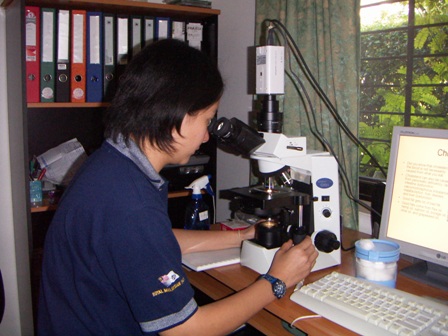
We see here: Ms. Nakamon from Bangkok and Ms. Yuki from Tokyo.
More information:
http://www.dreddyclinic.com/education/live_blood_3days.htm
Tuesday, November 27, 2007
Cranberry Sauce May Be Healthy Treat
 (HealthDay News) -- The cranberry on your Thanksgiving dinner plate may be more than a pleasant condiment, it may be good medicine, too, scientists say.
Compounds in cranberries may be able to protect against E. coli bacteria, -- which cause a number of human health problems, including gastroenteritis, kidney infections and tooth decay -- say researchers at Worcester Polytechnic Institute in Massachusetts.
A team led by Terri Camesano, an associate professor of chemical engineering at the institute, has uncovered a number of biochemical and biophysical mechanisms that may explain some of the health benefits attributed to cranberries, including cranberry juice's ability to prevent urinary tract infections (UTIs).
For example, they've found that a group of tannins (called proanthocyanidins or PACs) found primarily in cranberries interact with bacteria at the molecular level and prevent E. coli from attaching to cells in the body (a first step in infections) in a number of ways.
Among their findings:
- Chemical changes caused by cranberry juice create an energy barrier that prevents bacteria from getting close to the urinary tract lining.
- Cranberry juice causes compression of tiny tendrils on the surface of the type of E. coli that causes the most serious types of UTIs. Compression of these tendrils reduces the bacteria's ability to attach to the urinary tract lining.
- E. coli grown in cranberry juice or in PACs can't form biofilms, which contain high concentrations of bacteria and are required for infections to develop.
The research has been reported in a number of publications and presentations.
More information
The U.S. National Center for Complementary and Alternative Medicine has more about cranberry.
more discussion: Forum
· Addiction Forum · Ask the Doctors Forum · Ayurveda Forum · Ayurvedic & Thai Herbs Forum · Colon Cleansing Forum · Dental Forum · Diabetes Forum · Diet Forum · General Cleansing Forum · Hepatitis A, B. C Forum · Integrated Medicine Forum · Live Blood Analysis Forum · Ozone-Oxygen-Forum · pH - Alkaline - Acidity Forum · Weight Loss Forum
Friday, October 19, 2007
Study Reveals E.Coli's Grip on Gut U.S
(HealthDay News) -- U.S. scientists have discovered how a potentially deadly form of E. coli bacteria adheres to and colonizes the gut.
Enterohemorrhagic Escherichia coli O157:H7A, or E. coli, is a common cause of food poisoning.
The authors of the study hope the breakthrough will one day help with disease prevention strategies. But others say breakthroughs like that are still far off.
"The study was conducted in vitro, not in an animal model, human or otherwise," noted Dr. Pascal James Imperato, distinguished service professor and chair of the department of preventive medicine and community health at the State University of New York Downstate Medical Center in New York City. "Whether this in vitro result is reflective of what happens in vivo [in the gut] remains to be demonstrated."
There are several strains of E. coli and one in particular, E. Coli 0157:H7, can be deadly.
Human infections most often result from eating uncooked ground beef, because cattle carry the pathogen in their intestines without getting sick. E. coli can also be acquired from consuming contaminated dairy products, vegetables, unpasteurized juice, through person-to-person contact and through either swimming in or drinking water contaminated with sewage.
Infection with E. coli 0157:H7 can result in abdominal cramps and bloody diarrhea and, less commonly, a condition called hemolytic uremic syndrome (HUS), which is characterized by anemia and kidney failure and can end in death.
The U.S. Centers for Disease Control and Prevention estimate that 73,000 infections and 61 deaths are attributable to E. coli 0157:H7 each year. The very young and the very old are particularly prone to developing life-threatening HUS.
For this study, the researchers at the University of Arizona, Tucson, found that several proteins bind together to form a structure known as an adhesive type IV pilus, that they call hemorrhagic coli pilus (HCP). This HCP bundle allows the bacteria to attach to human intestinal epithelial cells, the researchers said.
The authors also found that individuals with HUS had an immune response to one component of HCP.
The research group is now looking to start experiments in animals and/or humans. "In our lab, we did in vitro experiments, but we are trying some collaboration with other universities to do some in vivo [in animals/humans] experiments," said Partha Samadder, a postdoctoral fellow in the lab of Jorge A. Giron, the study's lead author.
"Overall, it all has to be corroborated by others," Imperato said. "All that said, meaningful therapeutic interventions to prevent this cascade of molecular biological events will be years off. Meanwhile, the key is to prevent these infections in the first place."
There are ways to help prevent foodborne illness. They include:
Enterohemorrhagic Escherichia coli O157:H7A, or E. coli, is a common cause of food poisoning.
The authors of the study hope the breakthrough will one day help with disease prevention strategies. But others say breakthroughs like that are still far off.
"The study was conducted in vitro, not in an animal model, human or otherwise," noted Dr. Pascal James Imperato, distinguished service professor and chair of the department of preventive medicine and community health at the State University of New York Downstate Medical Center in New York City. "Whether this in vitro result is reflective of what happens in vivo [in the gut] remains to be demonstrated."
There are several strains of E. coli and one in particular, E. Coli 0157:H7, can be deadly.
Human infections most often result from eating uncooked ground beef, because cattle carry the pathogen in their intestines without getting sick. E. coli can also be acquired from consuming contaminated dairy products, vegetables, unpasteurized juice, through person-to-person contact and through either swimming in or drinking water contaminated with sewage.
Infection with E. coli 0157:H7 can result in abdominal cramps and bloody diarrhea and, less commonly, a condition called hemolytic uremic syndrome (HUS), which is characterized by anemia and kidney failure and can end in death.
The U.S. Centers for Disease Control and Prevention estimate that 73,000 infections and 61 deaths are attributable to E. coli 0157:H7 each year. The very young and the very old are particularly prone to developing life-threatening HUS.
For this study, the researchers at the University of Arizona, Tucson, found that several proteins bind together to form a structure known as an adhesive type IV pilus, that they call hemorrhagic coli pilus (HCP). This HCP bundle allows the bacteria to attach to human intestinal epithelial cells, the researchers said.
The authors also found that individuals with HUS had an immune response to one component of HCP.
The research group is now looking to start experiments in animals and/or humans. "In our lab, we did in vitro experiments, but we are trying some collaboration with other universities to do some in vivo [in animals/humans] experiments," said Partha Samadder, a postdoctoral fellow in the lab of Jorge A. Giron, the study's lead author.
"Overall, it all has to be corroborated by others," Imperato said. "All that said, meaningful therapeutic interventions to prevent this cascade of molecular biological events will be years off. Meanwhile, the key is to prevent these infections in the first place."
There are ways to help prevent foodborne illness. They include:
- Make sure ground beef and other meats as well as eggs are well cooked before you eat them.
- Wash raw fruits and vegetables with soap. Pay particular attention to leafy greens as there are lots of crevasses and cracks where E. coli can hide.
- Don't chop vegetables on the same block where you just made beef hamburgers or prepared other meat. Keep raw meat separate from ready-to-eat foods.
- Keep raw and ready-to-eat foods completely separate.
- Refrigerate leftovers promptly.
- Avoid bruised produce such as tomatoes.
- Make sure all cooking utensils including meat thermometers and cutting boards are thoroughly cleaned with soap and hot water after you've handled them.
- Wash your hands regularly with soap and hot water.
- Drink only pasteurized milk, juice or cider.
- Drink municipal water that has been treated with chlorine or another disinfectant.
More information
There's more on E. coli at the U.S. Centers for Disease Control and Prevention.
Thursday, September 27, 2007
Caffeine Plus Acetaminophen Toxic for Some
(HealthDay News) -- Very high doses of caffeine and acetaminophen (such as Tylenol), taken together, could lead to liver damage, researchers warn.
This combo produces a byproduct enzyme that's toxic to the organ, researchers from the University of Washington report.
This toxic twosome can occur not only by drinking caffeine while taking acetaminophen, the experts added, but also from large doses of painkillers that combine caffeine and acetaminophen.
These painkillers are often used to treat migraines, menstrual discomfort and other conditions.
"Caffeine can interact with an enzyme that can form a toxic metabolite of acetaminophen in such a way that it increases the formation of that toxic metabolite," said lead researcher Sid Nelson, a professor of medicinal chemistry. "This can result in liver damage," he said.
In the study, Nelson's team tested the effects of acetaminophen and caffeine on E. coli bacteria.
These bacteria had been genetically engineered to mimic a human enzyme in the liver that detoxifies many prescription and nonprescription drugs, explained the authors in a report in the Oct. 15 issue of the journal Chemical Research in Toxicology.
Nelson noted that it takes large qualities of caffeine to produce this reaction.
"Normally people wouldn't be ingesting that amount of caffeine," he said. "It would take 10 times the amount of caffeine found in a couple of cups of coffee," Nelson said.
His team found that caffeine triples the amount of a toxin called N-acetyl-p-benzoquinone imine (NAPQI) produced by the enzyme as it breaks down acetaminophen.
This same toxin is also produced during an interaction between alcohol and acetaminophen that's also well known to damage the liver.
In prior studies, Nelson's team had found that high doses of caffeine boosted liver damage in rats that had already suffered acetaminophen-linked liver damage.
The bacteria used in the study were exposed to doses of acetaminophen and caffeine far higher than most people would be exposed to, Nelson noted. It's not clear at what point such a mixture becomes toxic, he said.
Some people may be more vulnerable to this toxic interaction than others, Nelson said. They might include people who take certain antiepileptic medications, such as carbamazepine and phenobarbital, and people who use the alternative remedy St. John's Wort.
These drugs increase levels of the enzyme that produces NAPQI and may produce even more when mixed with acetaminophen and caffeine together, Nelson speculated.
In addition, because alcohol can boost NAPQI production, people who drink a lot may be at increased risk for this toxic interaction, the researcher said. The risk is also increased for people who take drugs that combine acetaminophen and caffeine, used to treat migraines, arthritis and other conditions.
Still, for most people, there's no reason to panic, since the chances of caffeine and acetaminophen becoming a toxic mixture remains small, Nelson said.
"Almost all people don't need to worry about taking caffeine with acetaminophen," Nelson said.
Exceptions might be, " those [people] taking high does of caffeine, high doses of acetaminophen, who are possibly alcoholic and/or are epileptic and take certain anticonvulsive drugs," he said.
More information
For more on acetaminophen, visit the U.S. National Library of Medicine.
more discussion: Forum
· Addiction Forum · Ask the Doctors Forum · Ayurveda Forum · Ayurvedic & Thai Herbs Forum · Colon Cleansing Forum · Dental Forum · Diabetes Forum · Diet Forum · General Cleansing Forum · Hepatitis A, B. C Forum · Integrated Medicine Forum · Live Blood Analysis Forum · Ozone-Oxygen-Forum · pH - Alkaline - Acidity Forum · Weight Loss Forum
This combo produces a byproduct enzyme that's toxic to the organ, researchers from the University of Washington report.
This toxic twosome can occur not only by drinking caffeine while taking acetaminophen, the experts added, but also from large doses of painkillers that combine caffeine and acetaminophen.
These painkillers are often used to treat migraines, menstrual discomfort and other conditions.
"Caffeine can interact with an enzyme that can form a toxic metabolite of acetaminophen in such a way that it increases the formation of that toxic metabolite," said lead researcher Sid Nelson, a professor of medicinal chemistry. "This can result in liver damage," he said.
In the study, Nelson's team tested the effects of acetaminophen and caffeine on E. coli bacteria.
These bacteria had been genetically engineered to mimic a human enzyme in the liver that detoxifies many prescription and nonprescription drugs, explained the authors in a report in the Oct. 15 issue of the journal Chemical Research in Toxicology.
Nelson noted that it takes large qualities of caffeine to produce this reaction.
"Normally people wouldn't be ingesting that amount of caffeine," he said. "It would take 10 times the amount of caffeine found in a couple of cups of coffee," Nelson said.
His team found that caffeine triples the amount of a toxin called N-acetyl-p-benzoquinone imine (NAPQI) produced by the enzyme as it breaks down acetaminophen.
This same toxin is also produced during an interaction between alcohol and acetaminophen that's also well known to damage the liver.
In prior studies, Nelson's team had found that high doses of caffeine boosted liver damage in rats that had already suffered acetaminophen-linked liver damage.
The bacteria used in the study were exposed to doses of acetaminophen and caffeine far higher than most people would be exposed to, Nelson noted. It's not clear at what point such a mixture becomes toxic, he said.
Some people may be more vulnerable to this toxic interaction than others, Nelson said. They might include people who take certain antiepileptic medications, such as carbamazepine and phenobarbital, and people who use the alternative remedy St. John's Wort.
These drugs increase levels of the enzyme that produces NAPQI and may produce even more when mixed with acetaminophen and caffeine together, Nelson speculated.
In addition, because alcohol can boost NAPQI production, people who drink a lot may be at increased risk for this toxic interaction, the researcher said. The risk is also increased for people who take drugs that combine acetaminophen and caffeine, used to treat migraines, arthritis and other conditions.
Still, for most people, there's no reason to panic, since the chances of caffeine and acetaminophen becoming a toxic mixture remains small, Nelson said.
"Almost all people don't need to worry about taking caffeine with acetaminophen," Nelson said.
Exceptions might be, " those [people] taking high does of caffeine, high doses of acetaminophen, who are possibly alcoholic and/or are epileptic and take certain anticonvulsive drugs," he said.
More information
For more on acetaminophen, visit the U.S. National Library of Medicine.
more discussion: Forum
· Addiction Forum · Ask the Doctors Forum · Ayurveda Forum · Ayurvedic & Thai Herbs Forum · Colon Cleansing Forum · Dental Forum · Diabetes Forum · Diet Forum · General Cleansing Forum · Hepatitis A, B. C Forum · Integrated Medicine Forum · Live Blood Analysis Forum · Ozone-Oxygen-Forum · pH - Alkaline - Acidity Forum · Weight Loss Forum
Monday, September 17, 2007
Erasing Pathogens: Laser Blasts Viruses in Blood
Johns Hopkins University student Shaw-Wei David Tsen, immunology researcher in the laboratory of T.C. Wu at Hopkins’ Kimmel Cancer Center, sought a new method to rid isolated blood of dangerous pathogens, including the viruses HIV and hepatitis C.
He says current techniques using UV irradiation and radioisotopes can leave a trail of mutated or damaged blood components. Using ultrasonic vibrations to destroy viruses was one possibility, but his father, Kong-Thon Tsen, a laser expert at Arizona State University, had a better idea: Lasers, unlike ultrasound, can penetrate energy-absorbing water surrounding the viruses and directly vibrate the pathogen itself.
The researchers aimed a low-power laser with a pulse lasting 100 femtoseconds into glass tubes containing saline-diluted viruses that infect bacteria, also known as bacteriophages. The amount of infectious virus within each cube plummeted 100- to 1000-fold after the laser treatment. “I had to repeat the experiment several times to convince myself that the laser worked this well,” says the younger Tsen. “Our laser repeatedly sends a rapid pulse of light and then relaxes, allowing the solution surrounding the virus to cool off,” Tsen says. “This significantly reduces heat damage to normal blood components.”
Building on the idea that vibration wrecks a virus’ outer shell, the scientists found that their low-power laser selectively destroys viruses and spares normal human cells around them, while stronger beams kill almost everything.
Father and son speculate that laser vibrations could destroy drug-resistant and -sensitive viruses alike. Wu says that the technique his student developed “could potentially be used to control communicable diseases by giving infusions of laser-treated blood products.”
Source: Johns Hopkins Medical Institutions
He says current techniques using UV irradiation and radioisotopes can leave a trail of mutated or damaged blood components. Using ultrasonic vibrations to destroy viruses was one possibility, but his father, Kong-Thon Tsen, a laser expert at Arizona State University, had a better idea: Lasers, unlike ultrasound, can penetrate energy-absorbing water surrounding the viruses and directly vibrate the pathogen itself.
The researchers aimed a low-power laser with a pulse lasting 100 femtoseconds into glass tubes containing saline-diluted viruses that infect bacteria, also known as bacteriophages. The amount of infectious virus within each cube plummeted 100- to 1000-fold after the laser treatment. “I had to repeat the experiment several times to convince myself that the laser worked this well,” says the younger Tsen. “Our laser repeatedly sends a rapid pulse of light and then relaxes, allowing the solution surrounding the virus to cool off,” Tsen says. “This significantly reduces heat damage to normal blood components.”
Building on the idea that vibration wrecks a virus’ outer shell, the scientists found that their low-power laser selectively destroys viruses and spares normal human cells around them, while stronger beams kill almost everything.
Father and son speculate that laser vibrations could destroy drug-resistant and -sensitive viruses alike. Wu says that the technique his student developed “could potentially be used to control communicable diseases by giving infusions of laser-treated blood products.”
Source: Johns Hopkins Medical Institutions
Wednesday, May 23, 2007
The Fairy Tale of E-coli Causing Sickness and Death
This was an email sent to me today concerning E-coli from spinach causing sickness or even death. It came as a result, I am quite sure, of the AOL news coverage and the hour-long CNN documentary which has been running all weekend about the spinach scare in 2006, farming practices, the problems of the FDA, the wrongly theorized cause, the supposed remedies, and lawsuits and so on.
It also highlighted the death of an elderly woman and the near-death of a little girl. I am always a bit suspicious and fearful of news media, like politicians, who spend too much time telling me what to be afraid of and who to blame." This is especially true when most of the accompanying ads seem to be from the pharmaceutical industry.
I am sharing with you my thoughts and response to questions. The host and interviewer of the piece was Dr. Sanjay Gupta, CNN's medical correspondent.
Here is the email letter:
"Dear Dr. Young "I was just wondering if the "germ" finds a friendly environment (over acidic), can it multiply and create more waste and therefore there is a possibility of exposure that leaves an acidic body in jeopardy.
"Obviously E-coli has been used for ages in classrooms (because it doesn't take much to provide it with the necessary ingredients for quick replication for observation) without hurting anyone, but if for some reason, some crazy kid decided to lick his slide and the internal terrain was compromised already, would the e-coli (or any other bacteria) then be able to replicate internally and produce enough waste to tip the balance (though I would have thought it would take ages)? Or is that really out of the question? Clearly the focus is bas-ackwards (as they say) in western etiology.
"When a group of kids who have been mistakenly identified as being "struck" by E-coli from a bad meat source, is it simply that the "'bad" (is there any good? : ) meat has become so acidic that it is like drinking industrial solvents? Would chemical tests of the suspect sources reveal the problem? Biological interpretations appear to be just wrong.
"Thank you so much for taking the time to answer these!"
Sally
Dear Sally: Thank you for your email questions. I have stated in my writings that germs (the "germing" process) cannot cause disease but "germs" themselves do produce digestive (enzymes) or metabolic waste products called exotoxins and mycotoxins or simply acids that contribute to disease states.
I have further stated that there is only one cause of sickness, dis-ease and death and that is the over acidification of the tissues (latent tissue acidosis) and then blood (compensated acidosis and then decompensated acidosis) due to an inverted way of living, eating and thinking.
Your question of whether or not bacteria can cause disease is an important question that has been debated for over 100 years. As you know, the French scientist, Antione BeChamp, an adversary of Louis Pasteur, said, "the germ is nothing; the terrain is everything."
Maintaining the healthy alkaline environment or terrain of the human body is critical for good health and for the prevention of any disease. The human body is alkaline by design and acidic by function. That is, the body is designed to run on primarily alkaline fuel because all bodily functions create acids which must be largely neutralized to protect the body itself from the acidic creation of disease and dis-ease.
The body maintains this alkaline pH design at 7.365 by eliminating gastrointestinal and metabolic acids through urination, perspiration, defecation and respiration. When we eat anything, including highly alkaline spinach, there will be residues of acids that can be easily buffered from the sodium bicarbonate produced and released in the stomach. So what comes first the bacteria or the acid? What we have here is the chicken or the egg scenario. I would suggest to you that everything is the prey of life and nothing is the prey of death. What can be nourished can be consumed and everything is simply trying to live.
Since our bodies run on energy in the form of electrons, the by-products of energy consumption is always acid. When acids from the process of metabolism are not properly eliminated, they can spoil our cells that make up our tissues that then gives rise to biological transformations known as bacteria.
So the answer to the question, "what comes first the bacteria or the acid?" the answer is clearly the ACID. Acid is the bi-product of energy being used or consumed. Bacteria is then a by-product of energy being consumed like the smoke from a fired gun, of spoiling or degenerating matter not the cause of the spoiling or degenerating matter. ACID is the only cause for spoiling of degenerating matter or tissue! In today's headline on AOL News it said, "Two More Deaths Possibly Linked to Tainted Spinach." A key word in this headline is "possibly" which infers that scientific investigators just don't know! And I believe that they know that they don't know. But they are going to try and calm your fears--and so they are going to come up with some sort of explanation that they can sell to the public.
But I am convinced that tainted or fermenting spinach which would contain very little amounts of oxalic acid and not enough to make one sick and it would ordinarily be neutralized by the sodium bicarbonate secreted in the mouth, stomach and intestines. Why? Because if spinach is that tainted or fermenting it would have a terrible smell, a terrible taste, and unlikely that anyone in their right mind would eat it. States of ultimate sickness, disease and then death comes as a process of poor lifestyle and dietary choice that then lead to a state of over acidity. The oxalic acid from a few leaves of Spinach could not possibly shut down the kidneys.
Now consider this: Most people get their spinach from sealed plastic bags designed to keep the spinach fresh for awhile. My bet would be that of the 250 or so spinach leaves in that one bag, NO SINGLE LEAF came from even the same plant. By the time the leaves are separated from the plant, washed and rewashed, tumbled and tossed, run over the multiple conveyer belts, those leaves came from all over the farm field, and sometimes from different truck loads and possibly even different fields--all in the same bag at your grocery store.
Have you ever seen the size of those commercial spinach fields? They look like a square mile or bigger. And there is field after field after field. Perhaps we are sophisticated enough to track a bag from the consumer, back to the store, back to the packager, and back to the commercial farmer, and maybe even back to one or two farm fields. But the chance that the FDA or any governmental agencies is sophisticated enough to isolate e-coli down to a few plants or area of a field is beyond my comprehension and certainly my confidence in the U.S. government.
In that enormous field, whatever they found, it is my guess that they would have found approximately the same thing anywhere in the field. And they could go next farm over and find the same results. Thousands of bacteria are everywhere as a product of evolution and a stage of life transforming.
You say the spinach field was too close to a field of cattle? Have you ever driven through California or most other states and looked at the farms? There are thousands of cattle fields and hog farms in proximity to fields of trees, plants and vegetables. There's e-coli everywhere. You have had plenty of e-coli come and go in your body. Fifteen million e-coli bacteria can sit on the head of a pin. I also believe that a hundred thousand people ate spinach leaves from the same field, and if there was some E-coli present, thousands and thousands of people ate those leaves and did not get sick.
What I do know and what I do believe is that many people could conceivable had perhaps some miniscule amount of bacteria, as we all do, from whatever source, and yet, the blood cells, tissues, and rivers/fluids of these peoples' bodies were acidic to begin with.
This internal-external distinction is important because it helps us in the treatment of the dis-ease as we change our focus from the bacteria to the state of over-acidity pH versus the actual alkaline pH of the fluids of the body. And if someone is taken to the hospital with whatever symptoms, they are then treated with a myriad of acidic components, including antibiotics, adding fuel to a fire already started. Rather than using acidic drugs to kill some harmless bacteria, the focus should change to reestablishing the alkaline internal pH environment with alkaline buffers such as sodium bicarbonate.
But hospitals do not do that because they are operating from the same wrong-headed theory as are many governments of the world, U.S. health agencies, medical schools, research laboratories, and lastly the 1,000 pound pharmaceutical gorillas that--along with your tax dollars--fund the whole she-bang.
To suggest that those individuals died from E-coli found in the kidney is like blaming the smoke from a fired gun as the cause of death. Logically we know that smoke from a fired gun cannot kill. We can even argue that it is not the bullet that can kill. It is the person that is pulling the trigger that causes the gun to be fired that causes the release of the bullet and then the residue of smoke. E-coli is the smoke. The bullet is the acid. And the triggering factor is the individual's lifestyle and dietary choices.
Not for a moment do I believe that anyone, unless staving to death, would eat spoiled fermenting smelly and awful tasting spinach. I do not believe that people are that silly, and I am not about to believe the ridiculous claims that spinach was the possible cause of death as suggested by western germ theory scientists. To justify their claims, these medical savants are now saying that E-coli is the possible villain in this fairy tale by suggesting that it is coming from migrant workers who are urinating and defecating in the fields around the spinach, or the nearby cattle and their excrement, or the pig farm, or the water run off that soaked an area of the field.
I can hardly contain myself from laughing out loud when organic farmers are using chicken excrement to fertilize the fields of spinach and other vegetables and fruits, and it certainly is not all "treated" fertilizer. Here at Rancho del Sol, we have used chicken excrement in and around our organic grapefruit and avocado trees for its oxygen and nitrogen components. This is what all organic farmers use. So what would be worse, human excrement or chicken excrement used to fertilize? The point is, we must focus on the cause not the effect and the cause will always be where you find the poison, or the acid, not the "germ" or the "germing process". As for Legionnaire's disease this also is not caused by bacteria. It is caused from over indulging in acidic foods and drinks. And plenty ate the same food and didn't get sick. And there are plenty of those who were sick that had been diagnosed with Legionnaire's where no bacteria could be found. The reason? Acid makes us sick not bacteria.
This is also the case with individuals diagnosed with HIV/AIDS. They are sick but there is no virus present! So what is the cause? It can only be from an over acidic environment. So, we need to look at the acid from our lifestyle and dietary choices.
The acid from the beverages we drink such as tea, coffee and alcohol. The toxins from meats that release nitric, uric, sulfuric, and phosphoric acids. Or the toxins from sugar like acetlyaldehyde or lactic acids. These are the true culprits or poisons that make us sick, tired and fat that lead to our eventual death. Finally you asked the following questions: The first was...I was just wondering that when the germ finds a friendly environment (over acidic), can it multiply and create more waste and therefore is there a possibility of exposure that leaves an acidic body in jeopardy. The word "germ" comes from the German language which means to sprout or germinate. Allow me to digress a moment. Germs are not really nouns, even though we think of them as "things" but they are not; "germ" should be a verb--or a noun derived from a verb. I think it should be a gerund if I remember my English correctly. A word that ends in "ing." It's not a thing so much as it's an activity. It should be called "germing." Instead we say germination and germinating.
"Germs" are the germinating function of changing matter and are NOT species specific, that is, they do note mate or reproduce. The reality is that germs are not things but actions or reactions from a changing environment. The germ or germination or germing is the expression of that change in matter and should never be classified. Simply, E-coli is a stage of transforming matter and not a reproduction due to an over acidic environment.
E-coli is the change of matter or tissue in a changed environment that is pH sensitive. It is no different than taking water, a liquid and seeing the change that takes place when we change the temperature to zero degrees Celsius and the water changes to ice, a solid. It is still water but in a different form. And so it is with E-coli. E-coli is a form of matter that is born out of the cell when the pH of the environment becomes acidic.
The second question was...obviously E-coli has been used for ages in class rooms (because it doesn't take much to provide it with the necessary ingredients for quick replication for observation) without hurting anyone, but if for some reason some crazy kid decided to lick his slide and the internal terrain was compromised already, would the e-coli (or any other bacteria) then be able to replicate internally and produce enough waste to tip the balance (though I would have thought it would take ages)? Or is that really out of the question? Clearly the focus is bas-ackwards (as they say) in western etiology? Once again germs cannot cause disease even if the child licks the slide. This experiment was done many years ago when Claude Bernard a French physiologist drank a glass of cholera bacteria with little affect other than some nausea. In fact, to prove my point I am willing to eat E-coli on fresh spinach leaves for CNN if they are willing and ready for the TRUTH! Another question was....when a group of kids who have been mistakenly identified as being "struck" by E-coli from a bad meat source, is it simply that the "bad" meat has become so acidic that it is like drinking industrial solvents? Industrial solvents differ greatly, but yes, depending upon some variables, eating any meat is highly acidic and would be like drinking industrial solvent, assuming their quantities and other factors were similar. Another question was....would chemical tests of the suspect sources reveal the problem?
Yes, if tested you would find an increase of specific acids in the suspected sources. Question....are biological interpretations....just wrong? You are right in your suspicions. Biological interpretation is wrong because scientists are focused on the matter rather than focused on the environment around the matter. It comes back to the fish bowl metaphor. When the fish is sick, do you treat the fish or change the water? Western medical science is focused on the fish, treats the fish and then neglects to clean up the environment not realizing that the fish is only as healthy as the environment it is swimming in.
This is true with the fluids of our body. If we find E-coli in the tissues, this is a transformation of the tissues due to the acidic fluids found in and around that tissue. There is no infection, only an outfection of matter giving birth to bacteria due to fluid acidosis. The key to staying healthy is to eat fresh organic greens whenever possible, to build healthy blood, and to help maintain the alkaline pH design of our body.
That includes eating lots of fresh organic spinach! Stay away from the acidic foods, liquids, supplements, and treatments. And especially stay away from those faulty or "acidic" theories of western scientific thought that are based upon a false belief that "germs" cause disease -- it could kill you. This fairy tale of E-coli causing sickness and death is just over the top, it smells of big money, and I see lots of dubious irradiation cost and solutions just down the road. Kindest Regards, Robert O. Young Ph.D.
It also highlighted the death of an elderly woman and the near-death of a little girl. I am always a bit suspicious and fearful of news media, like politicians, who spend too much time telling me what to be afraid of and who to blame." This is especially true when most of the accompanying ads seem to be from the pharmaceutical industry.
I am sharing with you my thoughts and response to questions. The host and interviewer of the piece was Dr. Sanjay Gupta, CNN's medical correspondent.
Here is the email letter:
"Dear Dr. Young "I was just wondering if the "germ" finds a friendly environment (over acidic), can it multiply and create more waste and therefore there is a possibility of exposure that leaves an acidic body in jeopardy.
"Obviously E-coli has been used for ages in classrooms (because it doesn't take much to provide it with the necessary ingredients for quick replication for observation) without hurting anyone, but if for some reason, some crazy kid decided to lick his slide and the internal terrain was compromised already, would the e-coli (or any other bacteria) then be able to replicate internally and produce enough waste to tip the balance (though I would have thought it would take ages)? Or is that really out of the question? Clearly the focus is bas-ackwards (as they say) in western etiology.
"When a group of kids who have been mistakenly identified as being "struck" by E-coli from a bad meat source, is it simply that the "'bad" (is there any good? : ) meat has become so acidic that it is like drinking industrial solvents? Would chemical tests of the suspect sources reveal the problem? Biological interpretations appear to be just wrong.
"Thank you so much for taking the time to answer these!"
Sally
Dear Sally: Thank you for your email questions. I have stated in my writings that germs (the "germing" process) cannot cause disease but "germs" themselves do produce digestive (enzymes) or metabolic waste products called exotoxins and mycotoxins or simply acids that contribute to disease states.
I have further stated that there is only one cause of sickness, dis-ease and death and that is the over acidification of the tissues (latent tissue acidosis) and then blood (compensated acidosis and then decompensated acidosis) due to an inverted way of living, eating and thinking.
Your question of whether or not bacteria can cause disease is an important question that has been debated for over 100 years. As you know, the French scientist, Antione BeChamp, an adversary of Louis Pasteur, said, "the germ is nothing; the terrain is everything."
Maintaining the healthy alkaline environment or terrain of the human body is critical for good health and for the prevention of any disease. The human body is alkaline by design and acidic by function. That is, the body is designed to run on primarily alkaline fuel because all bodily functions create acids which must be largely neutralized to protect the body itself from the acidic creation of disease and dis-ease.
The body maintains this alkaline pH design at 7.365 by eliminating gastrointestinal and metabolic acids through urination, perspiration, defecation and respiration. When we eat anything, including highly alkaline spinach, there will be residues of acids that can be easily buffered from the sodium bicarbonate produced and released in the stomach. So what comes first the bacteria or the acid? What we have here is the chicken or the egg scenario. I would suggest to you that everything is the prey of life and nothing is the prey of death. What can be nourished can be consumed and everything is simply trying to live.
Since our bodies run on energy in the form of electrons, the by-products of energy consumption is always acid. When acids from the process of metabolism are not properly eliminated, they can spoil our cells that make up our tissues that then gives rise to biological transformations known as bacteria.
So the answer to the question, "what comes first the bacteria or the acid?" the answer is clearly the ACID. Acid is the bi-product of energy being used or consumed. Bacteria is then a by-product of energy being consumed like the smoke from a fired gun, of spoiling or degenerating matter not the cause of the spoiling or degenerating matter. ACID is the only cause for spoiling of degenerating matter or tissue! In today's headline on AOL News it said, "Two More Deaths Possibly Linked to Tainted Spinach." A key word in this headline is "possibly" which infers that scientific investigators just don't know! And I believe that they know that they don't know. But they are going to try and calm your fears--and so they are going to come up with some sort of explanation that they can sell to the public.
But I am convinced that tainted or fermenting spinach which would contain very little amounts of oxalic acid and not enough to make one sick and it would ordinarily be neutralized by the sodium bicarbonate secreted in the mouth, stomach and intestines. Why? Because if spinach is that tainted or fermenting it would have a terrible smell, a terrible taste, and unlikely that anyone in their right mind would eat it. States of ultimate sickness, disease and then death comes as a process of poor lifestyle and dietary choice that then lead to a state of over acidity. The oxalic acid from a few leaves of Spinach could not possibly shut down the kidneys.
Now consider this: Most people get their spinach from sealed plastic bags designed to keep the spinach fresh for awhile. My bet would be that of the 250 or so spinach leaves in that one bag, NO SINGLE LEAF came from even the same plant. By the time the leaves are separated from the plant, washed and rewashed, tumbled and tossed, run over the multiple conveyer belts, those leaves came from all over the farm field, and sometimes from different truck loads and possibly even different fields--all in the same bag at your grocery store.
Have you ever seen the size of those commercial spinach fields? They look like a square mile or bigger. And there is field after field after field. Perhaps we are sophisticated enough to track a bag from the consumer, back to the store, back to the packager, and back to the commercial farmer, and maybe even back to one or two farm fields. But the chance that the FDA or any governmental agencies is sophisticated enough to isolate e-coli down to a few plants or area of a field is beyond my comprehension and certainly my confidence in the U.S. government.
In that enormous field, whatever they found, it is my guess that they would have found approximately the same thing anywhere in the field. And they could go next farm over and find the same results. Thousands of bacteria are everywhere as a product of evolution and a stage of life transforming.
You say the spinach field was too close to a field of cattle? Have you ever driven through California or most other states and looked at the farms? There are thousands of cattle fields and hog farms in proximity to fields of trees, plants and vegetables. There's e-coli everywhere. You have had plenty of e-coli come and go in your body. Fifteen million e-coli bacteria can sit on the head of a pin. I also believe that a hundred thousand people ate spinach leaves from the same field, and if there was some E-coli present, thousands and thousands of people ate those leaves and did not get sick.
What I do know and what I do believe is that many people could conceivable had perhaps some miniscule amount of bacteria, as we all do, from whatever source, and yet, the blood cells, tissues, and rivers/fluids of these peoples' bodies were acidic to begin with.
This internal-external distinction is important because it helps us in the treatment of the dis-ease as we change our focus from the bacteria to the state of over-acidity pH versus the actual alkaline pH of the fluids of the body. And if someone is taken to the hospital with whatever symptoms, they are then treated with a myriad of acidic components, including antibiotics, adding fuel to a fire already started. Rather than using acidic drugs to kill some harmless bacteria, the focus should change to reestablishing the alkaline internal pH environment with alkaline buffers such as sodium bicarbonate.
But hospitals do not do that because they are operating from the same wrong-headed theory as are many governments of the world, U.S. health agencies, medical schools, research laboratories, and lastly the 1,000 pound pharmaceutical gorillas that--along with your tax dollars--fund the whole she-bang.
To suggest that those individuals died from E-coli found in the kidney is like blaming the smoke from a fired gun as the cause of death. Logically we know that smoke from a fired gun cannot kill. We can even argue that it is not the bullet that can kill. It is the person that is pulling the trigger that causes the gun to be fired that causes the release of the bullet and then the residue of smoke. E-coli is the smoke. The bullet is the acid. And the triggering factor is the individual's lifestyle and dietary choices.
Not for a moment do I believe that anyone, unless staving to death, would eat spoiled fermenting smelly and awful tasting spinach. I do not believe that people are that silly, and I am not about to believe the ridiculous claims that spinach was the possible cause of death as suggested by western germ theory scientists. To justify their claims, these medical savants are now saying that E-coli is the possible villain in this fairy tale by suggesting that it is coming from migrant workers who are urinating and defecating in the fields around the spinach, or the nearby cattle and their excrement, or the pig farm, or the water run off that soaked an area of the field.
I can hardly contain myself from laughing out loud when organic farmers are using chicken excrement to fertilize the fields of spinach and other vegetables and fruits, and it certainly is not all "treated" fertilizer. Here at Rancho del Sol, we have used chicken excrement in and around our organic grapefruit and avocado trees for its oxygen and nitrogen components. This is what all organic farmers use. So what would be worse, human excrement or chicken excrement used to fertilize? The point is, we must focus on the cause not the effect and the cause will always be where you find the poison, or the acid, not the "germ" or the "germing process". As for Legionnaire's disease this also is not caused by bacteria. It is caused from over indulging in acidic foods and drinks. And plenty ate the same food and didn't get sick. And there are plenty of those who were sick that had been diagnosed with Legionnaire's where no bacteria could be found. The reason? Acid makes us sick not bacteria.
This is also the case with individuals diagnosed with HIV/AIDS. They are sick but there is no virus present! So what is the cause? It can only be from an over acidic environment. So, we need to look at the acid from our lifestyle and dietary choices.
The acid from the beverages we drink such as tea, coffee and alcohol. The toxins from meats that release nitric, uric, sulfuric, and phosphoric acids. Or the toxins from sugar like acetlyaldehyde or lactic acids. These are the true culprits or poisons that make us sick, tired and fat that lead to our eventual death. Finally you asked the following questions: The first was...I was just wondering that when the germ finds a friendly environment (over acidic), can it multiply and create more waste and therefore is there a possibility of exposure that leaves an acidic body in jeopardy. The word "germ" comes from the German language which means to sprout or germinate. Allow me to digress a moment. Germs are not really nouns, even though we think of them as "things" but they are not; "germ" should be a verb--or a noun derived from a verb. I think it should be a gerund if I remember my English correctly. A word that ends in "ing." It's not a thing so much as it's an activity. It should be called "germing." Instead we say germination and germinating.
"Germs" are the germinating function of changing matter and are NOT species specific, that is, they do note mate or reproduce. The reality is that germs are not things but actions or reactions from a changing environment. The germ or germination or germing is the expression of that change in matter and should never be classified. Simply, E-coli is a stage of transforming matter and not a reproduction due to an over acidic environment.
E-coli is the change of matter or tissue in a changed environment that is pH sensitive. It is no different than taking water, a liquid and seeing the change that takes place when we change the temperature to zero degrees Celsius and the water changes to ice, a solid. It is still water but in a different form. And so it is with E-coli. E-coli is a form of matter that is born out of the cell when the pH of the environment becomes acidic.
The second question was...obviously E-coli has been used for ages in class rooms (because it doesn't take much to provide it with the necessary ingredients for quick replication for observation) without hurting anyone, but if for some reason some crazy kid decided to lick his slide and the internal terrain was compromised already, would the e-coli (or any other bacteria) then be able to replicate internally and produce enough waste to tip the balance (though I would have thought it would take ages)? Or is that really out of the question? Clearly the focus is bas-ackwards (as they say) in western etiology? Once again germs cannot cause disease even if the child licks the slide. This experiment was done many years ago when Claude Bernard a French physiologist drank a glass of cholera bacteria with little affect other than some nausea. In fact, to prove my point I am willing to eat E-coli on fresh spinach leaves for CNN if they are willing and ready for the TRUTH! Another question was....when a group of kids who have been mistakenly identified as being "struck" by E-coli from a bad meat source, is it simply that the "bad" meat has become so acidic that it is like drinking industrial solvents? Industrial solvents differ greatly, but yes, depending upon some variables, eating any meat is highly acidic and would be like drinking industrial solvent, assuming their quantities and other factors were similar. Another question was....would chemical tests of the suspect sources reveal the problem?
Yes, if tested you would find an increase of specific acids in the suspected sources. Question....are biological interpretations....just wrong? You are right in your suspicions. Biological interpretation is wrong because scientists are focused on the matter rather than focused on the environment around the matter. It comes back to the fish bowl metaphor. When the fish is sick, do you treat the fish or change the water? Western medical science is focused on the fish, treats the fish and then neglects to clean up the environment not realizing that the fish is only as healthy as the environment it is swimming in.
This is true with the fluids of our body. If we find E-coli in the tissues, this is a transformation of the tissues due to the acidic fluids found in and around that tissue. There is no infection, only an outfection of matter giving birth to bacteria due to fluid acidosis. The key to staying healthy is to eat fresh organic greens whenever possible, to build healthy blood, and to help maintain the alkaline pH design of our body.
That includes eating lots of fresh organic spinach! Stay away from the acidic foods, liquids, supplements, and treatments. And especially stay away from those faulty or "acidic" theories of western scientific thought that are based upon a false belief that "germs" cause disease -- it could kill you. This fairy tale of E-coli causing sickness and death is just over the top, it smells of big money, and I see lots of dubious irradiation cost and solutions just down the road. Kindest Regards, Robert O. Young Ph.D.
Sunday, January 21, 2007
After 25 years of research studying the affects lifestyle and diet on the pH of the blood
 After 25 years of research studying the affects lifestyle and diet on the pH of the blood, I have learned that the human organism is alkaline by design and acidic in all of its functions. If one can maintain the delicate alkaline pH of all the body fluids bathing every cell from within and from without at 7.365 then life will continue without pain, suffering, sickness or disease.
Louis Pasteur's germ theory has become a curse. Antoine BeChamp an adversary to Pasteur and his germ theory for scientific fraud said this about the germ theory, "there is nothing so false that does not contain some element of truth, and so it is with the germ theory."
The germ theory is the controlling medical idea for the world. In Pasteur's day, and ever since, other proposed theories about the cause of disease have fallen on death ear because they have tended to contradict that paradigm. NO matter how simple and logical an idea about the cause of disease, if it does not promote the concept of invasion of germs and their specific cures it does not fit into the medical paradigm.
More importantly, the germ theory has become a curse because it has encouraged individuals to give up responsibility for their own health over to the medical community. If germs cause disease it stands to reason that control belongs to the medical community whose tireless researchers spend trillions of our money to find the right pill or potion to annihilate disease-causing germs.
This quest to cure disease through medication is at the heart of modern allopathic medicine and the multi-trillion dollar pharmaceutical industry. It is a quest that persists despite evidence indicating that airborne germs do not cause the disease for which they are credited.
After more than a century of trying, the Pasteurian germ theory has utterly failed in the quest to a cure for any disease. All major degenerative diseases are on the increase, as are so called infectious diseases which are not infectious at all. Every year, old symptoms are given new names - names like MS for polio, AIDS for poor sanitation, poor nutrition, poor lifestyle choices and drug use, Epstein-Barr virus for connective tissue disorders like fibramyalgia - to make them appear to be the work of a new germ. Unless we turn this nonsense around, the human race could become extinct like the dinosaurs from the treatments of modern medicine to kill a non- threatening or phantom germ.
If we want to find the cure for disease we need only to look at our dietary and lifestyle choices. If you heed the ignored, even rejected discoveries of Pasteur's peers and scientists of the 19th and 20th century, adding those to my own discoveries, you will learn the true cause of disease.
Until the medical community starts looking at causes rather than devoting its time looking for cures, and until we start taking responsibility for our own lifestyle and dietary choices, I believe the human race is in trouble of becoming extinct.
Dr. Benjamin Rush, Physician and signer of the Declaration of Independence, 1776 said this: "Unless we put medical freedom into the Constitution, the time will come when medicine will organize itself into an undercover dictatorship, To restrict the art of healing to one class of men and deny equal privileges to others will constitute the bastille of medical science. All such laws are un-American and despotic."
Where does life begin? In the womb or the grail, the holy grail, in the amniotic fluid, in a 98.6 F, one percent water and salt solution or 1 part salt to 100 parts water. This solution is called the sol. This natural salt solution, called "sol" is from the origin of the word, directly connected to the word "soul". What we call "sol" for our salt solution (a solution of two in one- no more polarity), was believed by the ancient Celtics to represent our soul, as the soul originated, in their belief, from the ocean where we are all born from the same fluids, arising from the same "sol" a solution of salt and water.
Our body in its wholeness is an ingenious creation of nature, It has been given all mechanisms to not only sustain its life but also to create new life. Every healthy person has innate regulatory mechanisms to maintain its alkaline design and self-healing powers, which ensure or reestablish the natural balance of the bodily functions, the homeostasis.
It is not the doctor that heals us, nor the medication, but our own innate alkaline regulatory mechanisms. Our body is able to fully regenerate itself. Therefore, it is advised to use great discernment before labeling any disease as "incurable" or "untreatable." If doctors come to the conclusion that a disease in incurable, they would be more accurate in saying that with their knowledge and experience, they are not able to offer any further help. The word "incurable" conveys fear, or false evidence appearing real, which stifles and weakens our body's innate alkaline mechanism.
Bio-chemically speaking Health is all about alkaline balance. Bio-energetically speaking Health is all about energy. Vibrating energy is the origin of matter and the origin of life. And matter is nothing more than organized energy.
In 1984, the Swiss physicist Dr. Carlos Rubbia, received the Nobel prize for discovering a mathematically calculable natural constant with which he could calculate the ratio of mass particles (matter) in relation to navigating energy particles, The ratio of matter to energy that forms matter is 1 to 9,746 to the power of 108 or about 1 to 1,000,000,000 which means it takes one billion energy units to create one single unit of matter in a materialized tangible form.
Isn't interesting that we for the most part, preoccupy ourselves with only 1 billionth part of reality: that which is in a material form and can be seen and touched. We fail to see the far greater amount of energy particles it took to materialize our reality. This revolutionary scientific discovery shows us clearly that every form of matter is subject to higher energetic interactions and subject to change of form and function.
When we analyze the energy content of any form of matter, we arrive at its smallest part, the atom and its protons, electrons and neutrons. There is ongoing movement without any contact- nothing tangible, just pure vibrating energy. This vibrating energy creates a frequency, which can be measured, a so-called wave length which can be seen using my photon interference photography. Every form of matter is characterized as a specific frequency spectrum.
And each frequency spectrum can be measured using a decibel meter. All organized matter is nothing more than organized energy that gives off a specific frequency and a specific sound which can be measured and heard. When we turn on a light or an electrical device we can see the energy but we cannot perceive the electrical current itself, but we except its existence.
This same materially non-perceivable electricity, this energy, flows through our body fluids especially our blood. Every one of us has enough measurable electrical cu rrent flowing through us to light up a 100 watt light bulb.
Life/light = energy and energy = information or intelligence. Everything that exists not only exists as energy but also as a carrier of information or intelligence, whether it is a human being, a form of food or drink, or a rock. Life is a constant exchange of energy and intelligence and the best place to view this life energy is in the live and dried blood.
Plasma which is 92% water is a good example for showing how matter as energy is transformed when additional energy is added or subtracted. Water has three different distinct bodies or states: solid, liquid and gaseous. Ice is frozen water or like the thickening of the blood.
We can see it and feel its coolness. By adding energy in the form of heat to the ice it transforms back into a liquid. When we add more energy to the water it begins to boil and the molecules start moving faster and faster that they begin to transform into steam and become gaseous. This transformation of organized energy as matter from one form to another is know as biological or energetical transformation or also referred to as pleomorphism.
Energy and intelligence are identical.
Every form of energy has a specific wavelength
Every wavelength has its individual content of intelligence
There are no accidents in the order of Nature
Meanwhile, we know of about 40,000 different diseases and the list is growing that are treated by the 1,200 different allopathic specialty fields with 58,000 different kinds of allopathic preparations or medicines. However, the word diseases in the plural form, is not a accurate.
Have you ever heard of "healths"? We are either healthy or ill. This illness signals a lack of energy and shows up in the form of a symptom. To represent a symptom as an illness is technically and scientifically inaccurate. The symptom is merely the intelligent cry of the energetically defective and suffering body, crying out for help. And normally, the body turns to a weakened organ to give us a hint, through a symptom, that things are not in order.
Our bodies either hum or honk Upset stomachs or high blood pressure or high blood sugars is the body honking. The honks of our bodies are telling us there is a state of pH or energetic imbalance.
Why does pH balance or pH Homeostasis define good health?
pH balance or pH homeostasis in humans commonly refers to the internal balance of the body's electro-magnetic and chemical systems in response to the changing conditions of the external world and the changing conditions of the internal world.
The word homeostasis comes from the Greek words: "homeo" means similar or "alki" or "alkaline" and "stasis" means a tendency toward maintaining stability. There are many homoeostatic mechanisms in our bodies that help maintain this balance and our state of health is directly related to the health of these mechanisms. pH homeostasis is maintained by dynamic processes of feedback and regulation.
pH homeostasis has only one objective: to preserve the beneficial conditions of life in the internal alkali environment. Every day we are bombarded with external influences that threaten that balanced internal alkaline pH environment. Some of these threats include becoming too hot or too cold, eating too much or eating acidic foods or drinks, breat hing polluted air and being exposed to chemicals over a period of time.
Our cells, especially the red blood cells can only survive when our bodies are strong enough to maintain pH homeostasis or to regain it quickly after we have been exposed to toxic environmental threats. Some of the pH homoeostatic mechanisms in the body include temperature regulation, dilation of the eye, blood composition, heart rate, blood pressure, water content, blood sugar level, mineral relationships, and of course the acid/alkaline balance of our body fluids. An essential feature of these mechanisms is that they enable the red blood cells, the tissue which is a product of the red blood cells and the whole of the organism, also a product of blood, to adapt to changes in both internal and external environmental conditions.
If the pH homoeostatic mechanisms are impaired the body loses its ability to regulate these mechanisms. By looking at living blood using a compound microscope we can view the quality of the red blood cell, its environment and how well the body is manag ing these pH homoeostatic mechanisms.
The interdependence and close coordination of the many bodily functions, which work so well when we are in alkaline balance or health, may be upset by a chain reaction when any part of the system breaks down from metabolic acids which have not been properly eliminated through, respiration, perspiration or urination. If this chain reaction is too drastic, the red blood cells and body cells will become acidic and begin to biologically transform into other cellular forms - like bacteria or yeast.
The normal state of health is not a static condition, but a coordination response of many systems and mechanisms. Fluctuations occur within a very narrow pH range. An imbalance of a point or two on the acid/alkaline pH scale is extremely disruptive to health. A few percentiles of variation of oxygen concentration in the blood can impair function.
In the bloodstream, the slightest changes can be observed in the structures of the red and white blood cells, the level of cellular debris, the creation of cholesterol or calcium crystals, etc. If the blood sugar content is continually elevated due to body cell transformation or breakdown, the body chemistry becomes upset. An infinitesimal deficiency of sodium, calcium, potassium or magnesium, the alkaline buffers of the body can cause a problem in the function of many body parts.
We must keep our pH homoeostatic mechanism strong so that we can deal effectively with our world. If we are humming and the process of pH homeostasis is orderly, life continues; if we are honking and the pH homeostasis is continually being disrupted, our health is in jeopardy.
pH Homeostasis is a bit like balancing the books in accounting. It is maintained by balancing inputs with outputs.
How well we adapt in health and sickness is largely a function of the pH homoeostatic mechanism. The body's chemistry response to such subtle changes that a negative thought, an acidic food or drink, or eating too much food can be a problem for maintaining balance.
In 1988 an article of the New England Journal of Medicine stated that, "most major chronic disease probably results from the accumulation of environmental factors over time in genetically susceptible people."
In 1965, Rene Dubos, a medical historian and philosopher, pointed out that the body is imperfect in its attempts to adapt and maintain pH homeostasis. She said, "the mechanisms involved in regulating homeostasis don not always return the body's functions to their original state. They can be misdirected. The body only has the ability to adapt to insults for so long. When it can no longer adapt , degeneration sets in. Health is the state that the body attains when an individual responds adaptively and restores the body to its original integrity."
The term "homeostasis" was coined in the mid-1920's by the American physiologist, Walter B. Cannon. But he was building on a concept of balance that dated back to ancient Western, Eastern, and Middle Eastern civilizations.
The balance equals good health equation was first suggested by Hippocrates (460-375 BC) and the ancient Greeks. Hippocrates considered health to be a state of harmonious balance and disease a state of disharmony. He and his contemporaries believed that harmony and balance existed between organs, between bodily fluids, and between body and soul. When the body is out of harmony and balance, illness occurs.
Hippocrates studied the entire patient in his or her environment, noting the effects of climate, food, and occupation on health. "Our natures are the physicians of our diseases, " he said, describing the healing forces we all have within us as the healing power of Nature. It was the physician's objective to restore harmony with food, exercise, rest, and with medicinal remedies designed to remove the harmful acidic excesses. This conservative approach was designed to let nature do the healing and above all, as Hippocrates said, "to first do no harm."
The Greeks ideas on equilibrium and health evolved further under the philosopher Aristotle (384-322 BC). He felt that a healthy body worked through what he described as a hemostat, a device that returns the body to a state of equilibrium even when it is subjected to stimuli that disturbs this balance. Everything is tied to this state of equilibrium, including the psyche and emotions, and nothing could be regarded as a separate component.
To lead a healthy life, the condition of balance had to be maintained, This could only be achieved if the body had an adequate feedback system, a means by which signals were transmitted to different parts of the body to help move it back into balance when it moved too far off alkaline center.
This psychological viewpoint was shared by another philosopher, Epicurus (341-270 BC). In his writing he referred to psychological stress and suggested that an individual's quality of life could be improved by coping with what we would now describe as emotional stressors.
As early as about 120 AD in India, Eastern philosophers had reached similar ideas about the importance of balance in health. A general medical textbook from that time, the Caraks, described health as a balance of bodily elements know as dhatus, and a happy mental state called prasana.
The Middle Eastern approach incorporated the Hindu teachings with the Greco-Roman medical doctrine. Being base upon both religious and philosophical ideas, Islamic healing involved both body and soul.
Over 1000 years later, during the Middle Ages in Europe, good health was still linked to this notion of balanced physical, emotional, and spiritual state. To help people achieve this state, European hospitals were set up by religious orders and attached to abbeys, monasteries, and convents. Doctors prescribed diet, rest, sleep, exercise, and salt baths.
In 1600 Thomas Sydenham had begun classifying diseases, even though he believed disease was a result of imbalance, consistent with Hippocrates and Galen.
In 1628 Harvey traced the circulation of the blood, arguably perhaps the single greatest achievement in medicine.
In 1753 James Lind showed that Scurvy could be reversed with the limes that contain limonene - an antitoxic or antacid.
Doctors began to lose their way in 1796. In 1796 Benjamin Rush observed that all fevers were associated with flushed skin, he concluded that this was caused by distended capillaries and reasoned that the proximate cause of fever must be abnormal "convulsive action" in these vessels. He took this a step further and conclude that all fevers resulted from disturbances of capillaries and since the capillaries were part of the circulatory system, he concluded that a hypertension of the entire circulatory system was involved.
Rush proposed to reduce this convulsive action by "depletion" or bleeding. A reminder that the medical establishment's acceptance of bleeding exists today in the name of the British Journal "The Lancet" one of the leading medical journals in the world. Today bleeding is called phlebotomy.
Also, In 1796 Edward Jenner took the pus from the runny sores of sick cows and injected it into the blood of his "patients. He thought that since pus is seen routinely in all kinds of wounds, pus was seen as a necessary part of healing.
In 1788 vaccinia was the bacteria that medical science suggested caused cowpox.
In 1830 the development of the first modern day achromatic microscope.
In 1835, Harvard's Jacob Bigelow argued in a major address that in "the unbiased opinion of most medical men of sound judgement and long experience . . . the amount of death and disaster in the world would be less, if all disease were left to itself."
In 1840 Jacob Henle in his essay, "On Miasmata and Contagia" first formulated the modern germ theory. He suggested that disease seem to germinate, grow and spread - like a first point or origin, a seed, a bacterium. The germ theory said that minute living organism invade the body, multiply and cause disease and that a specific germ causes a specific disease.
In 1850 Samule Thomson said, " May the time soon come when men and women will become their own priest, physicians and lawyers - when self-government, equal rights and moral philosophy will take the place of all popular crafts of every description . . False theory and hypothesis constitute nearly the whole art of medicine."
In 1860 Louis Pasteur suggested that living organisms, not a chemical chain reaction caused fermentation, winning converts to the germ theory.
In 1881 an American scientist George Sternberg was the first to isolate the fungus, pneumococcus and the first to observe the white blood cells engulfing bacteria, a key to understanding the immune system.
In 1882 a German, Robert Koch isolated the tubercle bacillus and declared it as the bacterium that caused tuberculosis that further confirmed the germ theory of Pasteur.
In 1884, German scientist Friedrich Loeffler isolated the diphtheria bacillus from throats of patients, grew it on a special medium (labs today call this Loeffler's serum slope to grow the bacteria from suspected cases), and began carful experiments in animals that took several years. His work suggested that the bacteria themselves did not kill; the danger came from a toxin, diptherium, an acidic poison that the bacteria excreted as a waste product from sugar metabolism.
In 1885 Max von Pettenkofer insisted that Koch's bacteria were only one of many factors in the causation of disease. His dispute with Koch became increasingly bitter and passionate. Petterkofer determined to prove himself right, prepared test tubes thick with lethal cholera bacteria. Then he and several of his students drank them down. All survived. Petterkofer claimed victory that germs do not cause disease.
In 1889 Pasteur's proteges, Emile Roux and Alexandre Yersin grew broth thick with diphtheria bacteria and used compressed air to force broth through a filter of unglazed porcelain. The filter was designed by Charles Chamber land, a physicist working with Pasteur; though only a tool, the filter itself would prove to be immensely important. NO bacteria or solids could pass through the porcelain. Only liquid could. They then sterilized this liquid. It still killed. That proved that bacteria, an insoluble could not kill, but a soluble, an acidic toxin did the KILLING.
The cure from diphtheria was not in killing the bacteria but neutralizing the acids or excretions from the bacteria.
In 1900 Frederick Gates and intellect and Baptist Minister and an assistant to John D. Rockefeller, saw an opportunity to exploit the medical field because of its admitted uncertainty and ignorance of the time. He had organized many business ventures for the Rockfellers' and convinced John D Rockefeller to open the Rockefeller Institute for Medical Research. The Rockefeller Institute saw medicine itself as its field from its earliest existence scientists studying disease based upon the germ theory of Pasteur.
In 1901, William Henry Welch was hired by John D. Rockefeller to set up the Rockefeller Institute for Medical Research. William Henry Welch was steeped in the germ theory and established its strong hold on the medical model. You might call Dr. Welch the Father of American Medicine and the perpetrator of the Pasteurian Germ Theory.
After the civil war medicine had discovered drugs - such as quinine, digitalis and opium of which Oliver Wendell Homes the physician Father of the Supreme Court justice said, "I firmly believe that if the whole materia medica, as now used, could be sunk to the bottom fo the sea, it would be all the better for mankind - and all the worse for the fishes."
In 1911, the head of the school training French army doctors in public health said that germs alone were "powerless to create an epidemic." But it was too late, this particular view was now considered simply a minority opinion. The germ theory now had its hold on the governments of the world!
IN 1911, the medical establishments made up a story that Peyton Rous discovered a bacteria that caused cancer and received a Noble Prize for his discovery posthumous in 1966. This gave rise to the term virus named after Peyton Rous's bacteria. Peyton Rous never suggested this in any of his research that his bacteria caused disease let alone cancer. This story gave rise to a new group of bacteria called filterable bacteria that the medical community now refers to as virus - beginning 1996. There is NO scientific evidence that shows that virus's have ever caused ANY disease.
These ideas of balance were some distance from those of earlier societies that ascribed illness to the supernatural powers they believed governed their lives. The Babylonians, the Egyptians, the ancient Americans saw disease as an entity unto itself, a potent demon that struggled to dominate, attacked, penetrated, and possibly even killed its unfortunate host.
Offend the Gods, an ancestor, or an evil witch and be struck down as punishment. Lead a sinful life and you were tempting fate.
Of course, we perceive that these ideas about disease are no longer widely believed, which makes it all more the ironic that Pasteur's germ theory has had and still has a stranglehold on 19th, 20th and now 21st century medicine. As medical writer Alberto Seguin described in an article entitled, "The Concept of Disease," the demonic idea of disease reached its full height with the germ theory. It became possible to bring together rational and scientific thought with irrational tendency to personalize disease. The germ in what ever name it is called, West Nile Virus, Ebola, Hunta, HIV, Anthrax, SARS and now AVIAN, are the scientific demon, the curse, the lie and the fraud that is said to attack and kill!
If we will consider disease as a symptom of disease not the cause, then the germ is nothing more than an expression of imbalance and a biological transformation of what use to be organized to that which is changing into a new form. This was my discovery in 1994. I witnessed biological transformation as seen on pg. 126 of my book "Sick and Tired" the transformation of a rod bacteria back into a red blood cell and then back into a bacterial rod.
I knew for the first time that bacteria was not a demon, not an entity but a transformation, a new formation of a preceding form. Not the cause of disease but the expression of a change in the internal environment which had given rise to change. For several years I felt alone in this discovery until I learned of the works of the giants that proceeded me that had their finger on the magic of life.
Claude Bernard (1813-1878) "The terrain is everything the germ is nothing." And upon the death bed of Louis Pasteur admitting to Claude Bernard that he was right in 1895.
Antoine BeChamp (1816-1908) "Disease is born in us and from us."
Florence Nightingale - a famous nurse (1820 -1910) Mathias Schleiden and Theodor Schwann (1839) Gunther Enderlein ((1872- 1968) Walter B. Cannon (1871-1945) "Only by understanding the wisdom of the body shall we attain the mastery of disease and pain that will enable us to relieve the burden of the people."
Royal Raymond Rife (1888-1971)
Wilhelm Reich (1897 - 1957)
Gaston Naessans (1924-2005)
Philosophically speaking, Pasteur had an ally in Napoleon III, who came to power in 1852. The Emperor believed in a police state and in using complete control to rule. Pasteur's mechanistic idea of disease, finding the right cure for each germ, fit into this philosophy of control.
Giving the responsibility to the any government to cure disease is giving up control. It takes responsibility - and power - away from the individual. In the words of Antoine BeChamp, "there is nothing so false that does not contain some element of truth and so it is with the germ theory."
One of six of us will become diabetic
One of two of us will develop cancer
One of two of us will develop cardiovascular disease One of six couples will suffer from unexplained infertility.
One of seven women in the US will develop breast cancer.
We need to get out to the disease business. If we want to understand health, energy and vitality then we need to study the people who are healthy. Over the last 25 years I have been studying health and how it relates to the blood. Viewing live and dried blood is the pinnacle of understanding health and how to achieve health with alkaline foods, drinks, exercise, breathing, getting adequate rest, etc.
Now, I pray and hope that you will realize that we are all responsible for our own health - you alone. A medical practitioner can only help to relieve symptoms. Ultimately, you are the one who has to take charge. Health is a choice just as disease is a choice. You are responsible for what goes into your mouth and what comes out of your mouth, as well as for what you think, feel and do. Health is all about choices and consequences.
The health and energy of the human organism is the knowledge that are bodies are alkaline by design and acidic by function and the best way to maintain that alkaline design is through an alkaline lifestyle and diet.
Related Courses
· Live Blood Analysis (3 days)
· Live Blood Analysis (6 days)
· Live Blood Analysis (80 hours)
· Live Blood Analysis online course (1year)
· Colon Hydrotherapy Course 45 hours (6 Days)
· Cleansing Combo Pack
· Microscope Equipment
Sunday, November 26, 2006
Confocal Microscopy Internet Resources
General Information - The growing utility and popularity of confocal microscopy has resulted in a dramatic increase in applications during recent years and, correspondingly, so have the number of sites on the Internet that address the subject. The links below constitute a selected collection from the best websites available today that provide general information about the history, theory, and practice of this exciting technique. Microscopists at all levels, from beginner to professional, may benefit from visiting many of these resources.
Antibodies - Antibodies are a large family of glycoproteins produced by specialized cells of the vertebrate immune system in response to foreign molecules (antigens). The interaction of an antibody with an antigen is the foundation upon which all immunochemical techniques have been developed. In confocal microscopy, such techniques are often extremely useful, enabling the researcher to localize antigens in cell cultures and tissue sections by utilizing antibodies labeled with fluorescent dyes that can be readily visualized with a confocal microscope. Also, in order to obtain a stronger signal, oftentimes an unlabeled primary antibody is used in conjunction with a labeled secondary antibody that binds to it. The resources provided in this section include many leading and emerging producers and distributors of primary and secondary antibodies.
Area Array (CCD and CMOS) Detectors - In recent years, optical microscopy has slowly migrated from a dependence on traditional photomicrography using emulsion-based film and has become increasingly reliant on technology that produces electronic images. Indeed, the choice of an imaging device is a critical decision for modern microscopists, but the range of light detection methods and the tremendous variety of imaging devices available can make the selection process difficult. This collection of area array detector resources is designed to simplify this process, providing links to many of the best sites on the Internet that offer CCD and CMOS detectors, as well as other imaging solutions to microscopists.
Digital Image Processing and Analysis - Despite the availability of the latest state of the art hardware, microscopists are often required to utilize advanced software for acquisition, processing, archiving, and retrieval of digital images in order to examine and reveal certain fine specimen details that would otherwise remain unseen. A wide range of companies offer such specialized software, providing consumers with a host of options for meeting the specific digital image processing and analysis requirements created by their application needs.
Fluorescence Filters - Fluorescence microscopy relies heavily on the ability to select a specific wavelength region for excitation of the specimen and gathering secondary emission during image formation. Recent advances in interference filter design have resulted in highly accurate filters that cover a wide range of bandpass profiles, ranging from just a few to tens and hundreds of nanometers. Listed below is a compilation of manufacturers that design, manufacture, and supply fluorescence filters to the microscopy community. The products that they offer will meet most system requirements, but if a specialized application necessitates a filter with an unusual spectral range or other unique specifications, many of the companies will fabricate custom filters.
Fluorescent Probes - Fluorescence is the property exhibited by many molecules of absorbing light at a particular wavelength and subsequently emitting light of longer wavelength after a brief interval in time. Some atoms and molecules fluoresce naturally, but others must be artificially altered or marked in some way to instigate the phenomenon. In confocal microscopy, fluorescent probes play a paramount role in the detection of anatomical structure and physiological reactions occurring in living cells. An extensive array of fluorescent probes are available from a number of distributors, the best of which have been compiled into the following list of Internet resources.
Fluorescent Protein Educational Websites - The discovery and development of fluorescent proteins from jellyfish and other marine organisms has drastically transformed cell research in recent years, providing life scientists with a minimally invasive means of studying protein dynamics and function in live cells and tissues. The websites listed in this section are an excellent educational starting point for individuals interested in broadening their knowledge of these unique investigative tools. Within the featured resources, information related to many different aspects of fluorescent proteins is available, including their history, attributes, and applications.
Fluorescent Protein Principle Investigators - Many of the scientists involved with research targeting various aspects of cell biology are using fluorescent proteins as imaging probes for cell structure, function, and dynamics. Several of the principle investigators have built extensive websites detailing their laboratories, and these sites are quite useful to visitors interested in learning more about this exciting and rapidly evolving research arena. Included in the information on a majority of the websites linked below are the current research interests, curriculum vitas, publications, lists of laboratory personnel, contact information, educational tutorials, image galleries, and digital videos.
Fluorescent Protein Vector Commercial Sources - A variety of fluorescent proteins, available as recombinant DNA plasmid vectors designed for transfection of mammalian cells or transformation of bacteria, are commercially available from a number of distributors. Most of the vectors containing fluorescent protein DNA sequences have been codon-optimized for expression in mammalian cells and contain antibiotic genes for selection of stable mutants having relatively constant expression levels. The vectors often contain multiple cloning sequences that enable researchers to easily insert their gene of interest for fusion to the fluorescent protein. Other common features in fluorescent protein vectors include a human cytomegalovirus (CMV) promoter, a Kozak translation initiation site, an early mRNA polyadenylation signal, and a bacterial antibiotic gene.
FluoViewTM Users Internet Resources - The FluoViewTM laser scanning confocal microscope is a key piece of equipment in laboratories around the world, being utilized for applications that range from quantitative cellular analysis to neuroanatomy, toxicology, molecular genetics, and zoological studies. A sampling of the many renowned universities and private research institutions that have benefited from this exciting Olympus technology is provided through the Internet links in this section.
Laser Systems - At one time limited only to the subject matter of science fiction stories, since their invention in the early 1960s, society has become increasingly dependent on lasers, utilizing the tools in a wide variety of instrumentation that ranges from barcode scanners and compact disk players to surgical equipment and interferometers. Indeed, lasers are the most common light source employed for scanning confocal fluorescence microscopy and, therefore, microscopists utilizing this technique should have a solid understanding of these powerful, radiation-emitting devices.
Live-Cell Imaging - One of the foremost targets in the life sciences is to understand the structure, function, and behavior of living organisms, and with evolving advances in technology, such as the development of confocal microscopy and fluorescent probes, it has become possible to pursue this goal at the cellular and subcellular levels. Still, working with and imaging live cells can be a complex, if not daunting, task to microscopists unfamiliar with the techniques and tools that are available. The following is a compilation of resources that offer overviews, background information, interactive forums, frequently asked questions, protocols, and hints that should aid any microscopist attempting to enter into this important, burgeoning field.
Live-Cell Imaging Specimen Chambers - The demands of modern confocal microscopy, especially those experiments involving the imaging of living cells and tissues, require that researchers take special precautions with their specimens. Indeed, simple microscope slides are unsuitable for many applications, resulting in the development of a broad range of specimen chambers, which can often supply the neccesary flexibility for live-cell imaging. The list of resources in this section exemplifies the great variety of specimen chambers that are commercially available, and is designed to help visitors locate the products that are best suited for their specific scientific pursuits.
Microscopy Courses and Workshops - A number of universities, research institutions, and organizations offer excellent courses, workshops, conferences, and symposia relating to confocal microscopy and its applications. The compilation of sites provided in this section are those belonging to groups that present these offerings on a regular basis, such as annually or biannually. Other highly useful courses and instructional events occur on a more sporadic schedule, and, therefore, this list of resources should be considered as a starting, rather than an ending, point for those seeking educational opportunities in the field.
Photometric Detectors - Photometric detectors, such as photomultiplier tubes and avalanche photodiodes, are the preferred photon detectors for a number of applications, including laser scanning confocal microscopy. A large number of companies, therefore, offer these forms of technology to the research and teaching community. This list of resources highlights the major developers, manufacturers, and suppliers of point source detectors, as well as some of the best sites on the Internet that offer background and conceptual information relating to them.
Three-Dimensional Volume Rendering - In order to obtain the most significant amount of information from the two-dimensional image stacks acquired through confocal microscopy, three-dimensional volume rendering software is necessary. In recent years, a vast array of software programs have been developed to help microscopists meet this critical need, many of which are open-source and freely available. Featured within this selection of three-dimensional volume rendering resources are websites that describe and distribute some of the most powerful software tools available to microscopists.
Related Courses
· Live Blood Analysis (3 days)
· Live Blood Analysis (6 days)
· Live Blood Analysis (80 hours)
· Live Blood Analysis online course (1year)
· Colon Hydrotherapy Course 45 hours (6 Days)
· Cleansing Combo Pack· Microscope Equipment
Antibodies - Antibodies are a large family of glycoproteins produced by specialized cells of the vertebrate immune system in response to foreign molecules (antigens). The interaction of an antibody with an antigen is the foundation upon which all immunochemical techniques have been developed. In confocal microscopy, such techniques are often extremely useful, enabling the researcher to localize antigens in cell cultures and tissue sections by utilizing antibodies labeled with fluorescent dyes that can be readily visualized with a confocal microscope. Also, in order to obtain a stronger signal, oftentimes an unlabeled primary antibody is used in conjunction with a labeled secondary antibody that binds to it. The resources provided in this section include many leading and emerging producers and distributors of primary and secondary antibodies.
Area Array (CCD and CMOS) Detectors - In recent years, optical microscopy has slowly migrated from a dependence on traditional photomicrography using emulsion-based film and has become increasingly reliant on technology that produces electronic images. Indeed, the choice of an imaging device is a critical decision for modern microscopists, but the range of light detection methods and the tremendous variety of imaging devices available can make the selection process difficult. This collection of area array detector resources is designed to simplify this process, providing links to many of the best sites on the Internet that offer CCD and CMOS detectors, as well as other imaging solutions to microscopists.
Digital Image Processing and Analysis - Despite the availability of the latest state of the art hardware, microscopists are often required to utilize advanced software for acquisition, processing, archiving, and retrieval of digital images in order to examine and reveal certain fine specimen details that would otherwise remain unseen. A wide range of companies offer such specialized software, providing consumers with a host of options for meeting the specific digital image processing and analysis requirements created by their application needs.
Fluorescence Filters - Fluorescence microscopy relies heavily on the ability to select a specific wavelength region for excitation of the specimen and gathering secondary emission during image formation. Recent advances in interference filter design have resulted in highly accurate filters that cover a wide range of bandpass profiles, ranging from just a few to tens and hundreds of nanometers. Listed below is a compilation of manufacturers that design, manufacture, and supply fluorescence filters to the microscopy community. The products that they offer will meet most system requirements, but if a specialized application necessitates a filter with an unusual spectral range or other unique specifications, many of the companies will fabricate custom filters.
Fluorescent Probes - Fluorescence is the property exhibited by many molecules of absorbing light at a particular wavelength and subsequently emitting light of longer wavelength after a brief interval in time. Some atoms and molecules fluoresce naturally, but others must be artificially altered or marked in some way to instigate the phenomenon. In confocal microscopy, fluorescent probes play a paramount role in the detection of anatomical structure and physiological reactions occurring in living cells. An extensive array of fluorescent probes are available from a number of distributors, the best of which have been compiled into the following list of Internet resources.
Fluorescent Protein Educational Websites - The discovery and development of fluorescent proteins from jellyfish and other marine organisms has drastically transformed cell research in recent years, providing life scientists with a minimally invasive means of studying protein dynamics and function in live cells and tissues. The websites listed in this section are an excellent educational starting point for individuals interested in broadening their knowledge of these unique investigative tools. Within the featured resources, information related to many different aspects of fluorescent proteins is available, including their history, attributes, and applications.
Fluorescent Protein Principle Investigators - Many of the scientists involved with research targeting various aspects of cell biology are using fluorescent proteins as imaging probes for cell structure, function, and dynamics. Several of the principle investigators have built extensive websites detailing their laboratories, and these sites are quite useful to visitors interested in learning more about this exciting and rapidly evolving research arena. Included in the information on a majority of the websites linked below are the current research interests, curriculum vitas, publications, lists of laboratory personnel, contact information, educational tutorials, image galleries, and digital videos.
Fluorescent Protein Vector Commercial Sources - A variety of fluorescent proteins, available as recombinant DNA plasmid vectors designed for transfection of mammalian cells or transformation of bacteria, are commercially available from a number of distributors. Most of the vectors containing fluorescent protein DNA sequences have been codon-optimized for expression in mammalian cells and contain antibiotic genes for selection of stable mutants having relatively constant expression levels. The vectors often contain multiple cloning sequences that enable researchers to easily insert their gene of interest for fusion to the fluorescent protein. Other common features in fluorescent protein vectors include a human cytomegalovirus (CMV) promoter, a Kozak translation initiation site, an early mRNA polyadenylation signal, and a bacterial antibiotic gene.
FluoViewTM Users Internet Resources - The FluoViewTM laser scanning confocal microscope is a key piece of equipment in laboratories around the world, being utilized for applications that range from quantitative cellular analysis to neuroanatomy, toxicology, molecular genetics, and zoological studies. A sampling of the many renowned universities and private research institutions that have benefited from this exciting Olympus technology is provided through the Internet links in this section.
Laser Systems - At one time limited only to the subject matter of science fiction stories, since their invention in the early 1960s, society has become increasingly dependent on lasers, utilizing the tools in a wide variety of instrumentation that ranges from barcode scanners and compact disk players to surgical equipment and interferometers. Indeed, lasers are the most common light source employed for scanning confocal fluorescence microscopy and, therefore, microscopists utilizing this technique should have a solid understanding of these powerful, radiation-emitting devices.
Live-Cell Imaging - One of the foremost targets in the life sciences is to understand the structure, function, and behavior of living organisms, and with evolving advances in technology, such as the development of confocal microscopy and fluorescent probes, it has become possible to pursue this goal at the cellular and subcellular levels. Still, working with and imaging live cells can be a complex, if not daunting, task to microscopists unfamiliar with the techniques and tools that are available. The following is a compilation of resources that offer overviews, background information, interactive forums, frequently asked questions, protocols, and hints that should aid any microscopist attempting to enter into this important, burgeoning field.
Live-Cell Imaging Specimen Chambers - The demands of modern confocal microscopy, especially those experiments involving the imaging of living cells and tissues, require that researchers take special precautions with their specimens. Indeed, simple microscope slides are unsuitable for many applications, resulting in the development of a broad range of specimen chambers, which can often supply the neccesary flexibility for live-cell imaging. The list of resources in this section exemplifies the great variety of specimen chambers that are commercially available, and is designed to help visitors locate the products that are best suited for their specific scientific pursuits.
Microscopy Courses and Workshops - A number of universities, research institutions, and organizations offer excellent courses, workshops, conferences, and symposia relating to confocal microscopy and its applications. The compilation of sites provided in this section are those belonging to groups that present these offerings on a regular basis, such as annually or biannually. Other highly useful courses and instructional events occur on a more sporadic schedule, and, therefore, this list of resources should be considered as a starting, rather than an ending, point for those seeking educational opportunities in the field.
Photometric Detectors - Photometric detectors, such as photomultiplier tubes and avalanche photodiodes, are the preferred photon detectors for a number of applications, including laser scanning confocal microscopy. A large number of companies, therefore, offer these forms of technology to the research and teaching community. This list of resources highlights the major developers, manufacturers, and suppliers of point source detectors, as well as some of the best sites on the Internet that offer background and conceptual information relating to them.
Three-Dimensional Volume Rendering - In order to obtain the most significant amount of information from the two-dimensional image stacks acquired through confocal microscopy, three-dimensional volume rendering software is necessary. In recent years, a vast array of software programs have been developed to help microscopists meet this critical need, many of which are open-source and freely available. Featured within this selection of three-dimensional volume rendering resources are websites that describe and distribute some of the most powerful software tools available to microscopists.
Related Courses
· Live Blood Analysis (3 days)
· Live Blood Analysis (6 days)
· Live Blood Analysis (80 hours)
· Live Blood Analysis online course (1year)
· Colon Hydrotherapy Course 45 hours (6 Days)
· Cleansing Combo Pack· Microscope Equipment
Subscribe to:
Posts (Atom)
Advanced Body Cleansing Kit $147.75  Advanced Body Cleansing Kit with Livatrex™, Oxy-Powder®, Latero-Flora™ and two bottles of ParaTrex®. |